




Gambling operators are increasingly using proactive approaches to identify customers who may be at-risk for gambling-related harm, to offer them support. One such approach is the use of care calls, where trained staff contact customers who show indicators of risky gambling behaviors. During these calls, staff talk with customers about their gambling, provide personalized feedback, and introduce responsible gambling tools such as limit setting. This week, The WAGER reviews a study by Jakob Jonsson and colleagues that examined changes in gambling behavior following care calls provided to customers of a large Norwegian gambling operator who were identified as at risk for gambling-related harm.
What was the research question?
How does the gambling behavior of at-risk customers change following care calls provided by a gambling operator?
What did the researchers do?
The researchers analyzed Norsk Tipping data from 4,752 customers who received a care call between 2022–2024. They grouped customers based on why they received a call, such as high gambling losses, high-risk classification through a player tracking system, or self-initiated contact through customer service or Norsk Tipping’s Spillepuls intervention.1 The researchers compared customers’ gambling outcomes2 during the 12 weeks before and the 12 weeks after the call. They also looked at responsible gambling actions taken during calls, such as reducing loss limits, and compared changes in gambling outcomes between customers who did and did not reduce their loss limit.
What did they find?
Fifty-seven percent of the 4,752 customers contacted completed a care call. In the 12 weeks after the call, the researchers observed small-to-medium decreases for each gambling outcome examined (see Figure, final column). Overall, the largest reductions were in the number of days they gambled and net losses. When considering all gambling outcomes together (i.e., final row of the Figure), customers who self-initiated contact through Spillepuls, new customers with high losses, and customers recently escalated to high-risk classification had the largest overall decreases. Customers over age 30 with high losses and those with a long-term high-risk classification had the smallest overall changes. Nearly 44% of customers reduced their loss limits during the call. Customers who reduced their limit had greater reductions in gambling frequency, net losses, amount wagered, and number of deposits in the following 12 weeks compared with customers who did not reduce their limit.
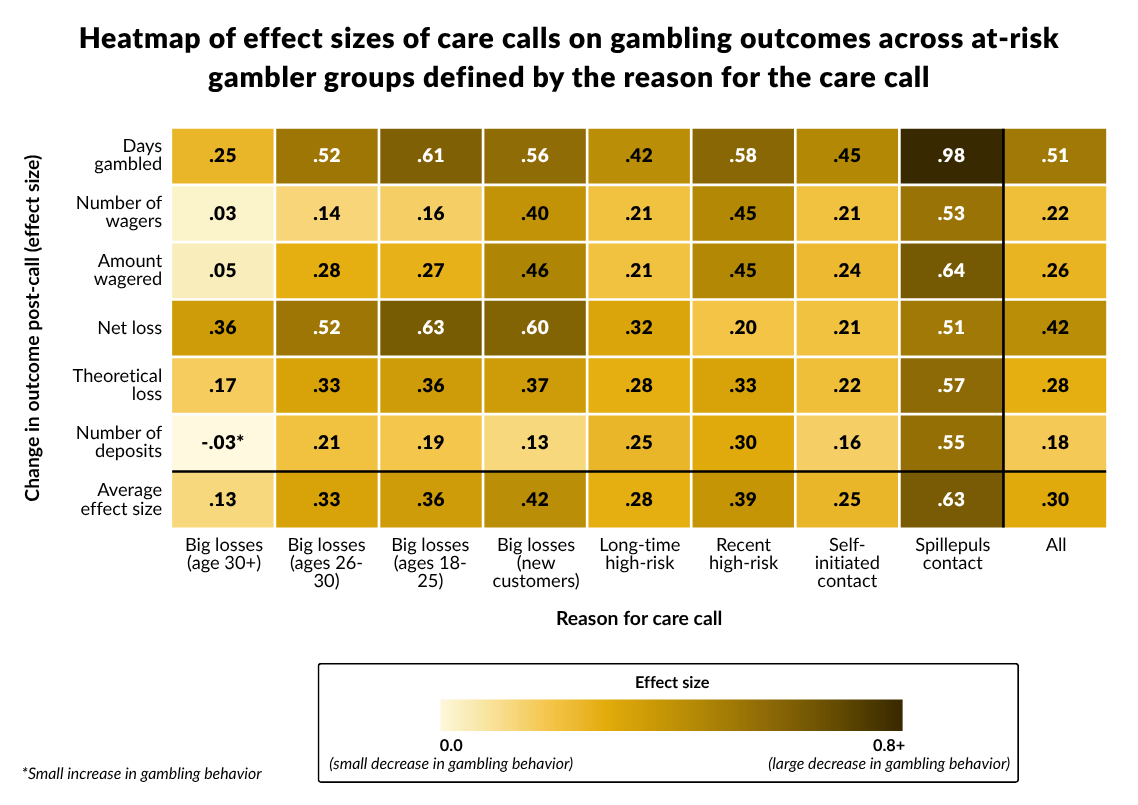
Figure. Heatmap of Cohen’s D effect sizes of care calls on gambling outcomes across groups of Norsk Tipping customers, grouped by the reason for the care call. A small positive number indicates a smaller decrease in gambling behavior; a larger positive number indicates a larger decrease in gambling behavior. A negative number indicates an increase in gambling behavior. Adapted from Jonsson et al. (2026). Click image to enlarge.
Why do these findings matter?
These findings suggest that care calls may be a useful way to engage customers, encourage the use of responsible gambling tools, and support harm reduction in gambling behavior. The timing and type of outreach may matter, as newer customers, younger customers, and those who self-initiated contact showed some of the largest changes following calls. Alternative approaches may be needed to engage customers with longer-term high-risk gambling. These findings support the role of proactive strategies as part of a duty of care approach, where gambling operators play an active role in identifying risk and offering support to customers who may be at risk for gambling harm.
Every study has limitations. What are the limitations in this study?
The findings may not generalize to other gambling operators or countries with different regulations, practices, and social contexts. Additionally, the study only captured gambling activity with Norsk Tipping. As a result, researchers could not determine whether customers reduced their overall gambling or instead shifted some of their gambling to other operators.
For more information:
Individuals who are concerned about their own or someone else’s gambling may benefit from visiting the National Council on Problem Gambling or Gamblers Anonymous. For additional resources, including gambling and self-help tools, visit our Addiction Resources page.
— Kira Landauer, MPH
Want CE credit for reading BASIS articles? Click here to visit our Courses Website and access our free online courses.
________________
1. Customers were categorized into eight groups based on the reason for the care call: high gambling losses among customers ages 18–25, ages 26–30, and ages 30+; high gambling losses among new customers; long-term or recent high-risk classification related to gambling behavior according to a player tracking system; and self-initiated contact with customer service or with Norsk Tipping’s Spillepuls intervention indicating potential gambling problems.
2. Gambling outcomes included days gambled, number of wagers, amount wagered, net loss (money lost after accounting for winnings), theoretical loss (an estimate of expected losses based on the amount wagered and the expected payout of games), and number of deposits made to gambling accounts.