




Many women completing treatment for substance use disorders could benefit from services that help them learn to cope with past experiences of sexual violence and intimate partner violence and reduce the risk of experiencing future violence. The Healthy Relationships and Interpersonal Violence Education (THRIVE) program was designed to be embedded into existing substance use treatment programs and delivered by trusted peers who advocate, educate, and serve as a bridge to formal care. This week, STASH reviews a pilot trial of THRIVE led by Heidi Zinzow and colleagues.
What was the research question?
Does a peer-delivered sexual and intimate partner violence prevention program demonstrate feasibility, acceptability, and preliminary effectiveness among women receiving substance use treatment?
What did the researcher do?
The researchers recruited 90 adult women receiving substance use treatment from three outpatient and residential treatment facilities. Participants took part in THRIVE, a two-session sexual and intimate partner violence prevention intervention delivered by trained peer support specialists. THRIVE provided education and skill-building around topics such as consent, healthy relationships, risk recognition, and protective behaviors. Participants completed self-report surveys before the intervention (baseline) and at 3-month follow-up assessing knowledge, attitudes, and behavioral intentions related to these topics.1 They also reported on recent experiences of sexual and intimate partner violence. The researchers used linear mixed models to examine whether these outcomes changed following participation in THRIVE. The researchers also evaluated the feasibility and acceptability of THRIVE by assessing participants’ satisfaction, engagement, and feedback about the program through exit interviews with a subset of participants.
What did they find?
At the 3-month follow-up, participants demonstrated increased knowledge of consent and available resources, greater confidence in resisting sexual aggression, and decreased intentions to engage in risky dating behaviors (see Figure). Participants also reported fewer recent experiences of intimate partner violence, although there was no significant change in recent experiences of sexual violence. The program was feasible and acceptable: nearly 79% of participants completed both sessions, and participants reported high satisfaction with THRIVE, describing it as informative, helpful, and engaging.
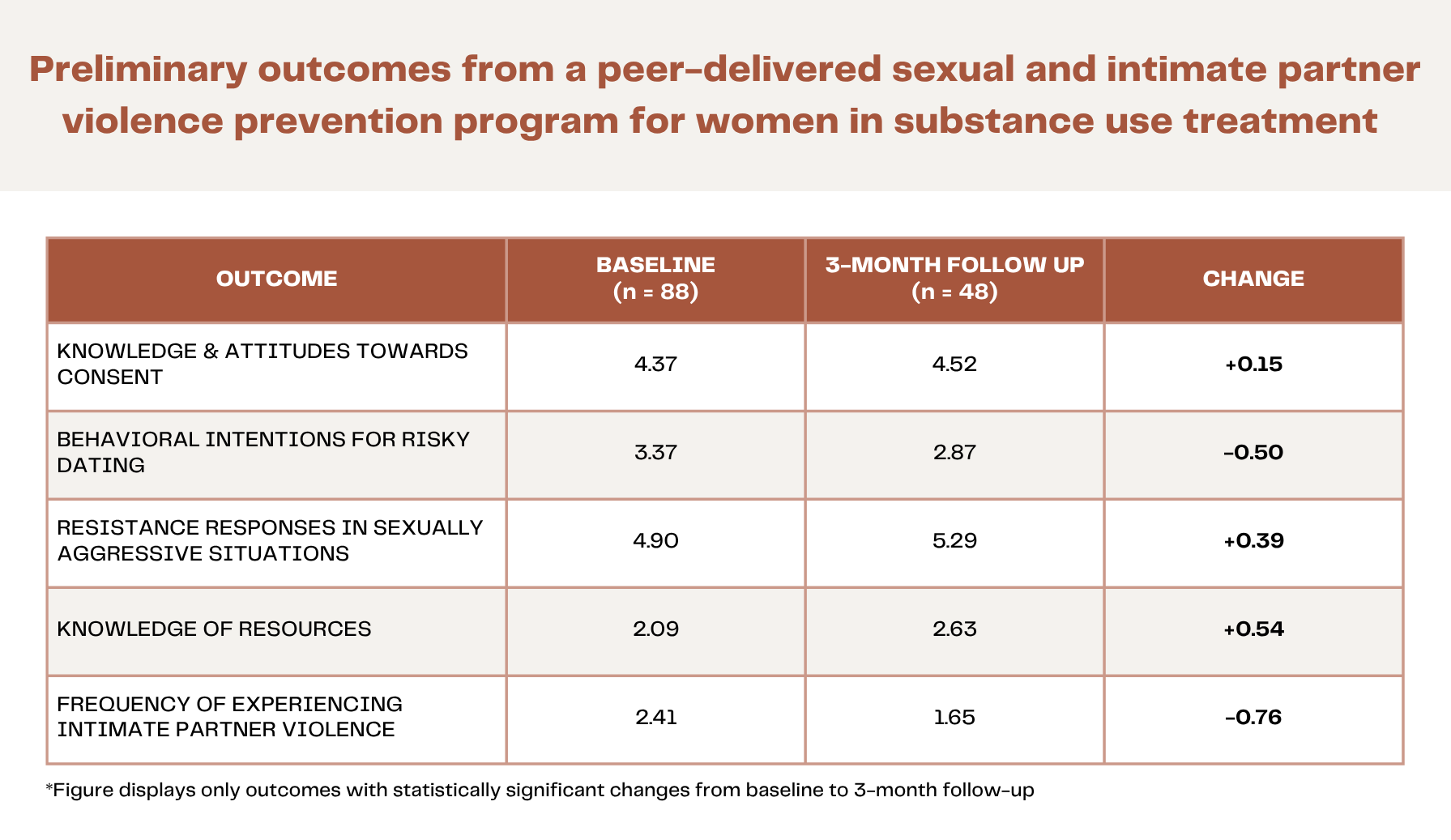
Figure. Statistically significant changes in mean scores of violence prevention-related outcomes from baseline to 3-month follow-up among participants in the THRIVE program. Outcomes without statistically significant changes are not shown. Click image to enlarge.
Why do these findings matter?
These results suggest that THRIVE is a promising violence prevention program for women completing treatment for substance use disorders. Just as importantly, they highlight potential ways to improve the program to benefit future participants. For instance, participants tended not to endorse problematic attitudes or beliefs about dating or sexual violence at baseline, so program time could be shifted away from education about these topics and more towards active skills training, with a particular focus on sexual violence and trauma help-seeking. The results also suggested a need for more education about the symptoms of PTSD. With future improvements, evaluation, and scaling, this program could help reduce the incidence of violence and mental health consequences among women completing substance use treatment.
Every study has limitations. What are the limitations of this study?
This study did not include a control group, so we can’t determine whether the observed improvements were due to the THRIVE program, participants’ substance use treatment, or other factors. In addition, many participants were in residential treatment during part of the study, which may have reduced their exposure to violence independent of the intervention. Finally, because the study included only women receiving substance use treatment with limited racial and ethnic diversity, the findings may not generalize to other populations.
For more information:
If you are worried that you or someone you know is experiencing addiction, the SAMHSA National Helpline is a free treatment and information service available 24/7. For additional general resources and tools, please visit the BASIS Addiction Resources page.
— Kira Landauer, MPH
Want CE credit for reading BASIS articles? Click here to visit our Courses Website and access our free online courses.
________________
1. Ninety participants were enrolled in the study. Eighty-eight completed the baseline survey. Seventy-one completed the intervention. Forty-eight completed the 3-month follow up.