




The rise in popularity and accessibility of sports betting in recent years has led to higher levels of gambling engagement and gambling problems among young adults. Therefore, it is important to understand how gambling exposure throughout young persons’ lives may lead to gambling harm as they become adults. This week, as part of our Special Series on Addiction Among Emerging Adults, The WAGER reviews a study by Nerilee Hing and colleagues that examined how childhood and early adulthood influences may contribute to gambling harm among young sports bettors in Australia.
What was the research question?
What early life influences may contribute to gambling harm among young adult sports bettors?
What did the researchers do?
The researchers interviewed 50 young adults (aged 18 to 25 years) residing in Victoria, Australia who reported at least moderate harm from sports betting in the past year. Each interview explored a participant’s chronological journey towards gambling, emphasizing major influences throughout their childhood and early adulthood such as gambling exposure, peer pressure, simulated gambling, and more. The researchers used thematic analysis to identify common themes among participants’ responses.
What did they find?
The researchers identified a master theme, the permeation of pro-gambling influences into all stages of participants’ lives, which consisted of three subthemes (see Figure):
- Childhood: Exposure to pro-gambling influences in everyday settings during childhood describes children being exposed to pro-gambling attitudes via family influence (e.g. parents having poker nights), gambling advertising, and engagement with simulated gambling such as video games with chance-based rewards.
- Adolescence: Escalating exposure to pro-gambling influences during adolescence describes adolescents increasing their attention to sports betting advertising, feeling a normalization of gambling among peers, increasing their engagement with simulated gambling, and becoming determined to gamble when legally able.
- Early adulthood: Immersion in pro-gambling influences in early adulthood describes young adults seeing gambling become a rite of passage to adulthood, feeling stronger peer influences to gamble in order to build relationships, and finding sports betting advertising inescapable.
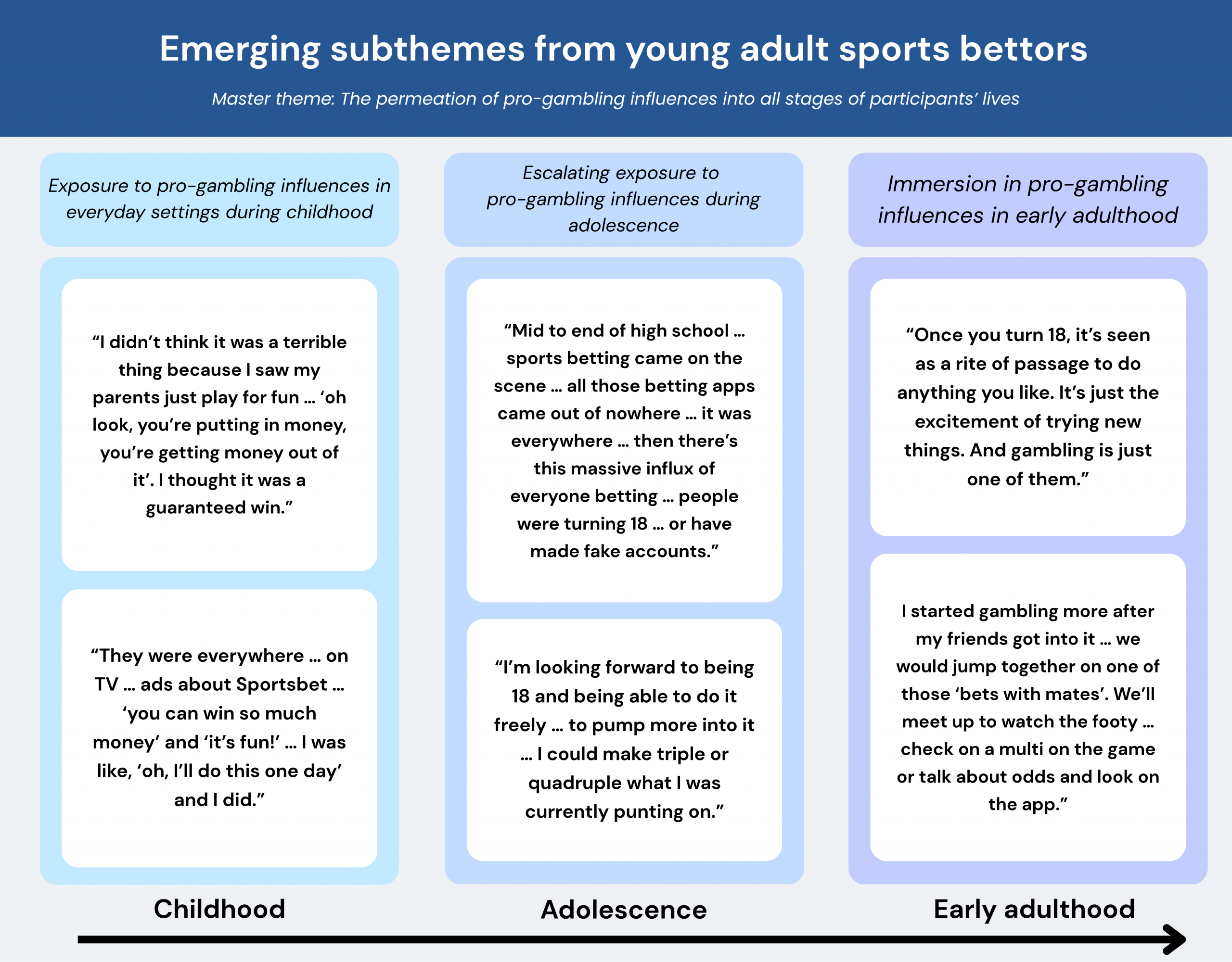
Figure. Subthemes from the early life experiences of young adult sports bettors, highlighted with example interview quotes. Click image to enlarge.
Why do these findings matter?
These findings emphasize that gambling generally, and sports betting more specifically, is becoming normalized in youth culture. Diverse stakeholders, such as policy makers and public health organizations should make efforts to minimize resulting harms. For example, regulators might put restrictions on sports betting advertising, especially those featured in non-gambling environments like sporting events. Alternatively, advertising should be promoted that features stronger counter-framing messaging that corrects young adults’ misperceptions about gambling and promotes safer activities.
Every study has limitations. What are the limitations in the study?
The study asks participants to report experiences over a lifetime, which might have been difficult to recall accurately. Further, due to potential stigma and the sensitive nature of gambling problems, participants might have been reluctant to disclose certain personal information. Lastly, Australia has an especially active and mature gambling industry. Therefore, the study’s findings may not generalize to other countries with a gambling landscape dissimilar to Australia’s.
For more information:
Visit the National Council on Problem Gambling or Gamblers Anonymous to access information for individuals with gambling problems. Additional resources on gambling can be found on The BASIS Addiction Resources page and the Division on Addiction’s materials for emerging adults.
— Justin Huynh, MPH
Want CE credit for reading BASIS articles? Click here to visit our Courses Website and access our free online courses.