




Tobacco use is a major public health concern for all ages but especially adolescents. Youth who start smoking early in life run the risk of experiencing negative health consequences that can persist into adulthood. Anti-tobacco campaigns such as Truth Initiative, The Real Cost, and Tips from Former Smokers, have been effective in raising awareness of the harms of tobacco use and deterring smoking initiation among youth. However, to optimize anti-tobacco messaging, we need to better understand the characteristics of youth who are exposed to these campaigns, and those who are not. This week, ASHES reviews a study by Rime Jebai and colleagues that evaluated youth’s awareness of anti-tobacco campaigns and whether disparities existed among their sociodemographic characteristics and health behaviors.
What were the research questions?
(1) Are youth aware of anti-tobacco campaigns and (2) are there any characteristics or behaviors that influence their level of awareness?
What did the researchers do?
The researchers analyzed data from Wave 7 of the Population Assessment of Tobacco and Health study (N = 10,568). Participants indicated their awareness of different anti-smoking campaigns (i.e., Truth Initiative, The Real Cost, and Tips from Former Smokers), demographic information, peer/household tobacco use, media exposure, smoking harm perceptions, current tobacco use/susceptibility, and physical/mental health status. The researchers used log-binominal regression models to assess campaign awareness and determined adjusted prevalence ratios for the other variables to learn how strongly they related to campaign awareness.
What did they find?
About two-thirds (65%) of participants reported being aware of The Real Cost, 52% of Truth Initiative, and 21% of Tips From Former Smokers. The researchers identified some individual-level factors that influenced participants’ awareness of each campaign. For example, older youth (ages 15-17) had higher odds than younger youth (ages 12-14) to report awareness of all three campaigns. Hispanic youth were less likely to report being aware of all three campaigns, compared to non-Hispanic youth. On the other hand, campaigns were, for the most part, equally effective in reaching youth who had already started using tobacco products as compared to those who hadn’t (see Figure).
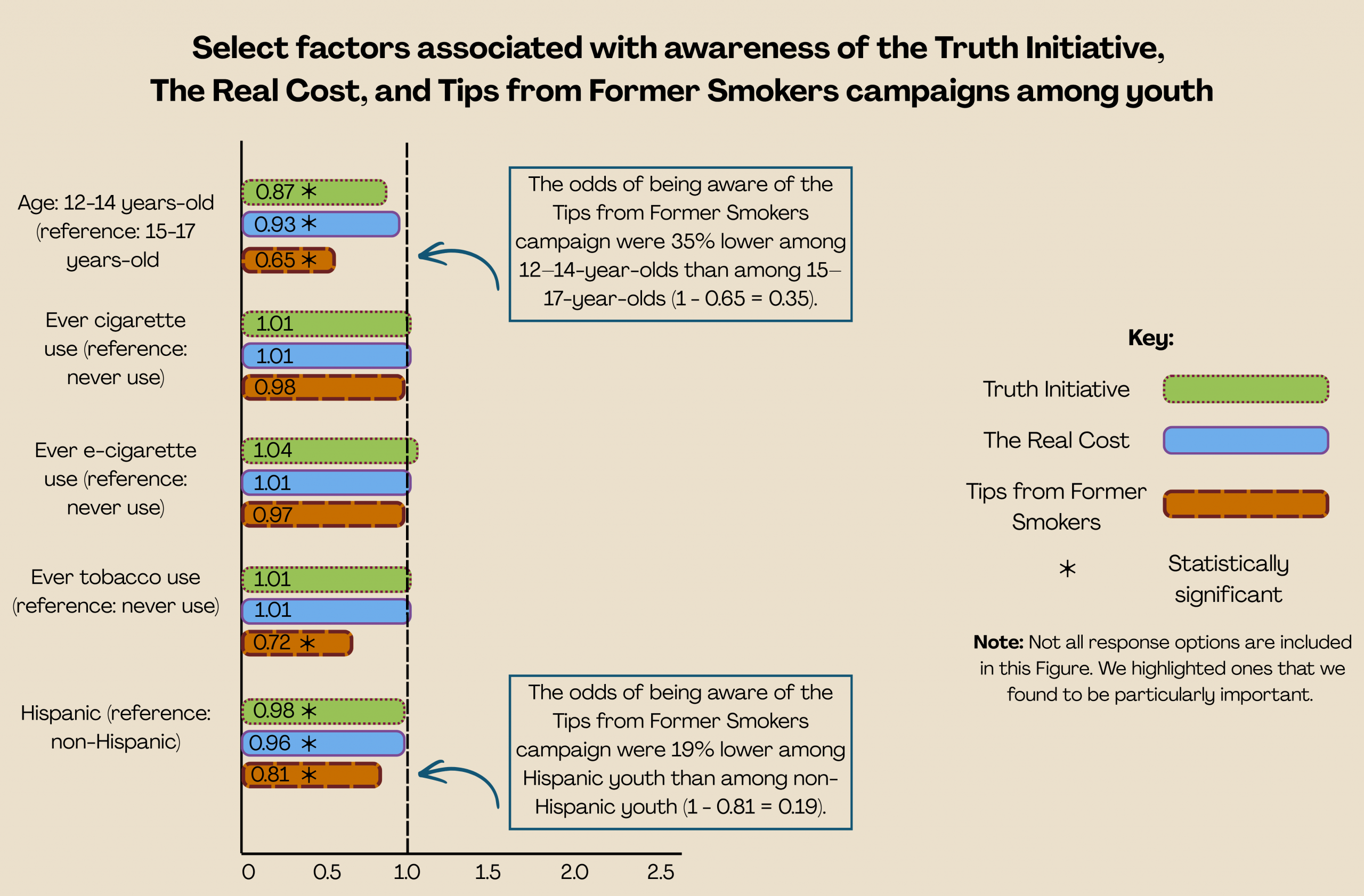
Figure. Displays the odds of reporting having ever seen an anti-tobacco campaign. Odds ratios can be interpreted as having X times greater/lesser odds of reporting an outcome compared to a reference group. Statistically significant relationships are denoted by *. Click image to enlarge.
Why do these findings matter?
According to this study, anti-tobacco campaigns were less effective in reaching younger adolescents and Hispanic youth. It is possible that younger individuals in this sample were not aware of campaigns because of restricted social media access or lack of exposure to advertisements promoted within content intended for older youth. Among Hispanic youth, who are highly susceptible to smoking behavior, culturally-tailored campaigns that involve collaborating with Latinx or Spanish-speaking organizations or leverage traditional Hispanic cultural values, like collectivism, might be more effective.
Every study has limitations. What are the limitations in this study?
The findings in the study are subject to self-report and recall bias. Additionally, campaign awareness was indicated by a “yes or no” response. This makes it impossible to determine what type of content participants saw, how often they saw ads, or whether they changed their behavior as a result of the ads.
For more information:
The CDC offers tools to educate youth and curb youth smoking. Parents who want to learn more about talking to their child about substance use should visit the SAMHSA page on having that conversation. Additional resources can be found at the BASIS Addiction Resources page.
— Nakita Sconsoni, MSW
Want CE credit for reading BASIS articles? Click here to visit our Courses Website and access our free online courses.