



Suicide is a significant public health concern impacting all populations, particularly military personnel. According to the Interpersonal Theory of Suicide, feelings of thwarted belongingness (i.e., feeling disconnected and unsupported) and perceived burdensomeness (i.e., feeling like a burden to others) can increase an individual’s risk for suicide. Research also suggests that alcohol misuse, which is common among military service members, can contribute to suicidal ideation. This week, The DRAM reviews a study by Grisel García-Ramírez and colleagues that explored the effects of military branch/status, alcohol use, and belongingness on suicidal ideation.
What was the research question?
Do alcohol misuse and belongingness affect the relationship between suicidal ideation and military branch/status among U.S. military service members?
What did the researchers do?
The researchers analyzed survey data of 2,516 U.S. service members, both active and inactive. Participants reported their military branch (i.e., Army, Air Force, Navy, and Marines)1 and service status (i.e., active/inactive), alcohol use, feelings of belongingness, and suicidal ideation. The researchers used linear regressions to examine the effects of military branch/status, alcohol misuse, and belongingness on suicidal ideation.
What did they find?
Alcohol misuse and belongingness, along with service branch and status, directly influenced suicidal ideation among service members (see Figure). Alcohol misuse moderated the association between military branch and suicidal ideation, but did not moderate the association between military status and suicidal ideation. More specifically, Marine and Navy members who misused alcohol reported more suicidal ideation than Army members, but active service members who misused alcohol did not report more suicidal ideation than inactive service members. In contrast to alcohol misuse, belongingness moderated effects of both military branch and and military status on suicidal ideation. For example, compared to Marines, Army members who reported greater feelings of belongingness experienced lower rates of suicidal ideation. Conversely, active duty members with feelings of thwarted belongingness reported higher rates of suicidal ideation compared to non-active duty members with feelings of thwarted belongingness.
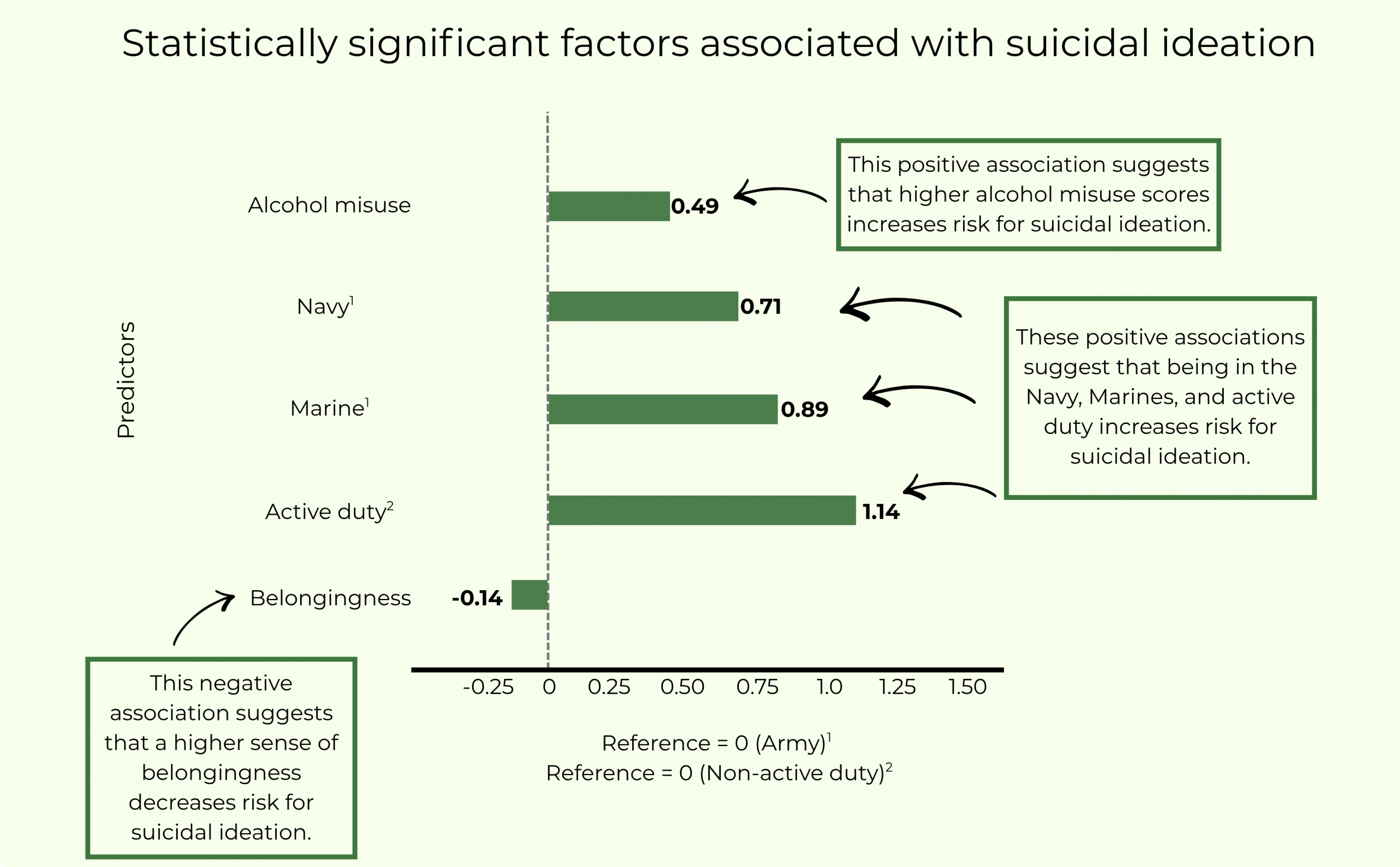
Figure. Represents statistically significant linear regression effects. There was a positive association between alcohol misuse and suicidal ideation and a negative association between belongingness and suicidal ideation. Higher rates of suicidal ideation existed for Navy and Marines, compared to Army, and for active duty members, compared to non-active duty members. Click image to enlarge.
Why do the findings matter?
Military service members who misuse alcohol and report higher thwarted belongingness are more likely to report suicidal ideation. These rates vary depending on military branch and status. As such, suicide prevention strategies should be tailored to reflect the culture and drinking norms of each branch and the deployment experiences of active members, such as combat exposure. Strategies should include wraparound care that addresses suicidal ideation, education on responsible alcohol consumption, and community-building resources that offer a space to connect with others.
Every study has limitations. What are the limitations in this study?
Although the Interpersonal Theory of Suicide identified two factors that contribute to the desire for suicide – thwarted belongingness and perceived burdensomeness – the researchers only looked at thwarted belongingness. Additionally, the single snapshot study design impacts our ability to determine causal effects.
For more information:
Visit the National Institute on Alcohol Abuse and Alcoholism for tips and resources for people struggling with problem drinking. For additional information and drinking self-help tools, please visit our Addiction Resources page.
— Nakita Sconsoni, MSW
Want CE credit for reading BASIS articles? Click here to visit our Courses Website and access our free online courses.
________________
1. Respondents reported on their enrollment in the following military branches: Army, Air Force, Navy, Marine, and Coast Guard. However, no respondents reported enrolling in the Coast Guard, so this branch was not included in the data analysis.