




Substance use often carries significant health risks. Injection drugs, for example, can cause increased risk of blood-borne diseases, largely due to the re-use of needles. Some of these risks can be reduced, however, via public health initiatives. To illustrate, practices like using clean needles can reduce infection from IV drug use. To counsel patients who use drugs about safer practices, healthcare professionals must first be made aware of their patients’ substance use, and substance use stigma often makes patients reluctant to disclose their substance use. This week, STASH reviews a study by Mathias Luderer and colleagues that explored how substance use stigma influences care-limiting behaviors in populations who use substances.
What was the research question?
(1) How does fear of substance use-related stigma influence the treatment experiences and disclosure patterns of people with addiction?
(2) Does internalized substance use stigma relate to these experiences and behaviors?
What did the researchers do?
One hundred and nineteen patients at an inpatient addiction unit in Germany completed surveys about their internalized substance use stigma (e.g., “I cannot contribute anything to society because I have an addiction“) and their history of (1) not disclosing their substance use to a treatment provider, (2) being reluctant to seek medical help when sick, and (3) discontinuing medical treatment, all due to fear of addiction stigma from healthcare providers. Using regression analyses, the researchers explored how internalized stigma relates to these three behaviors while accounting for their age, sex, and number of substance use disorder diagnoses.
What did they find?
Almost half of the sample had not disclosed substance use to a provider due to fear of worsened treatment. Sizable proportions of participants reported avoiding care due to that same fear and discontinuing treatment early due to fear of poor treatment (see Figure). Moreover, participants with more internalized stigma reported each of the three patient behaviors at higher rates compared to those who held less internalized stigma, controlling for participants’ age, sex, and number of substance use disorder diagnoses.
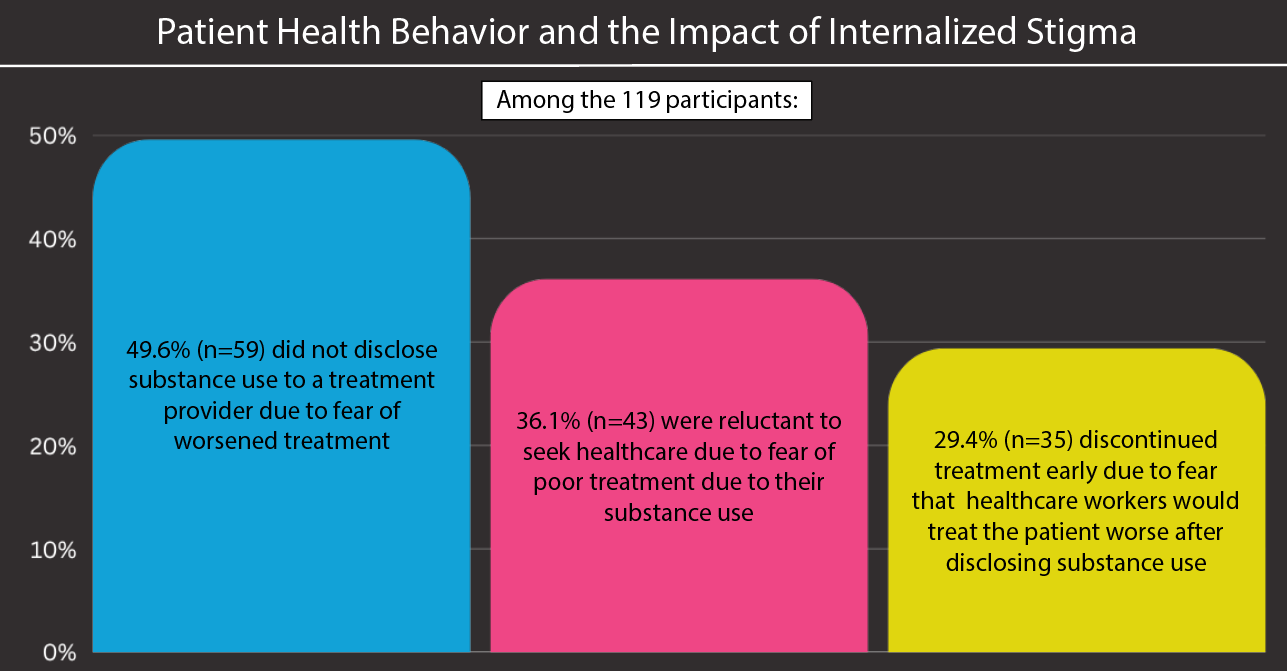
Figure. Displays the percentage and total number of participants who reported each of the three patient behaviors. Click image to enlarge.
Why do these findings matter?
Biases and stigma are well-known issues in the medical field that contribute to worsened health outcomes. This research builds on the existing work on substance use-related stigma and directly ties expected stigmas to healthcare decisions, underscoring the need to address these biases. Existing approaches to reducing substance use-related stigma, such as those outlined by the CDC (e.g., using person-first language), should be promoted and implemented at an organizational level. Furthermore, healthcare providers should reflect on whatever biases they may personally hold and review the strategies for addressing biases laid out by the National Center for Cultural Competence.
Every study has limitations. What are the limitations in this study?
This study included a relatively small sample (i.e., 119 participants), which made it difficult to detect some hypothesized effects. Also, the researchers assessed each of the patient behaviors using a single item, which may not capture the depth and nuance of healthcare seeking as well as multi-item measures.
For more information:
Individuals who are concerned about their substance use may benefit from exploring the CDC webpage on treating substance use disorders. Treatment professions who wish to reflect on and address their own internal biases should explore resources like the APAs webpage on addressing stigma in healthcare. Additional resources can be found at the BASIS Addiction Resources page.
— John Slabczynski
Want CE credit for reading BASIS articles? Click here to visit our Courses Website and access our free online courses.