




The parent-child relationship is one of the most important predictors of a child’s mental health and prosocial behavior. For example, this relationship influences educational outcomes as well as other behavioral and conduct issues. Notably, a parent’s influence also extends to their child’s future substance use behaviors. To better address harms from substance use, it is imperative that we understand the specific mechanisms of this relationship. This week, ASHES reviews a study by Sherri Jean Katz and colleagues that explored how the parent-child relationship influences youth vaping.
What was the research question?
How do parent-child relational factors influence youth vaping?
What did the researchers do?
The researchers used a Qualtrics research panel to identify 1,792 U.S. national quota-based sample of matched child-parent pairs. Eligible pairs included a parent and a child between the ages of 11-14. Parents completed measures on vape-related communication with their child (i.e., comfort discussing vape-related harms and whether those conversations have occurred), parenting style (authoritarian, authoritative, or permissive), and perceptions of their child’s vaping behavior, knowledge, and curiosity. The children completed measures on their knowledge, curiosity, and experience vaping. The researchers used logistic regression to identify predictors of parents’ knowledge of their kids’ knowledge, curiosity, and experience vaping.
What did they find?
Though most parents accurately reported their child’s vaping, 32.7% either underestimated or overestimated their child’s knowledge, 41.1% inaccurately estimated their child’s curiosity, and 14.2% their child’s vape experience. Authoritative parents – the group marked by their ability to set clear boundaries while using a warm and flexible approach – consistently estimated their child’s vape knowledge, curiosity, and experience more accurately, compared to those with a permissive or authoritarian parenting style. Children of authoritarian parents were more likely to report having vaped in the past month, compared to children of either authoritative or permissive parents. Interestingly, although parents who reported difficulties communicating about vaping with their children were more likely to have a child who vaped, so too did parents who had experience discussing vaping with their child (see figure).
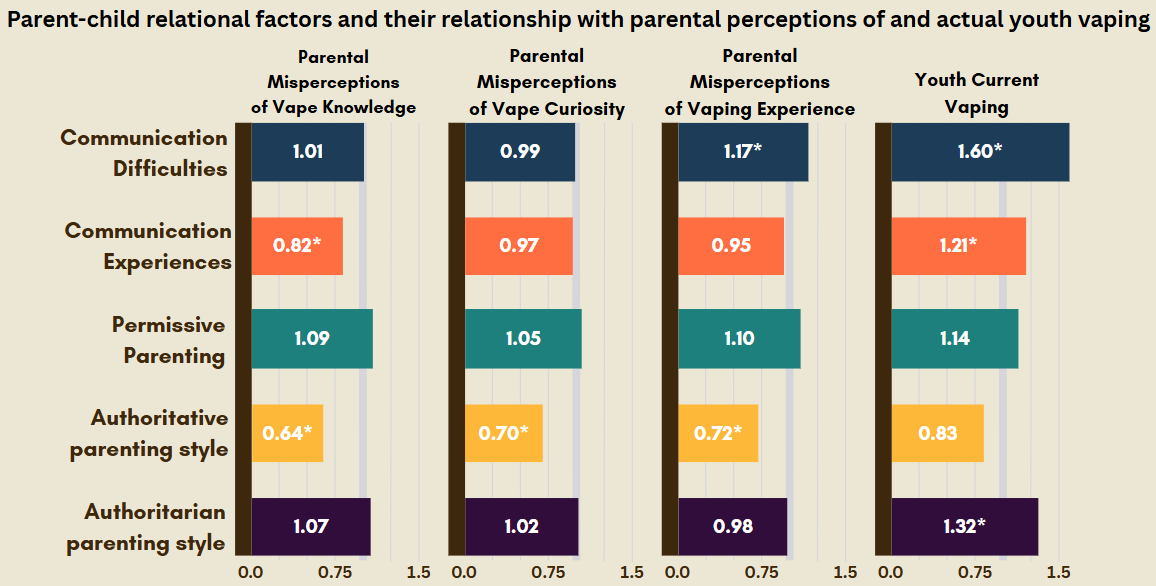
Figure: Displays the odds of having misperceptions about a child’s vape knowledge, curiosity, or experience, or of having a child who reported vaping, based on select parent-child relational factors. Odds ratios can be interpreted as having X times higher odds of reporting an outcome compared to a control group. For example, parents with an authoritarian parenting style had 1.32 times higher odds of having a child who currently vapes compared to parents with a different parenting style. Significant relationships are denoted by *.
Why do these findings matter?
These findings suggest that when talking to their child about vaping, parents should use the techniques outlined by the American Lung Association, where the conversational aspect is highlighted as key to an effective conversation rather than scare tactics and lists of facts. Programs aimed at strengthening family relationships such as those outlined in the Department of Justice’s Family Strengthening Initiative, should be further explored to better understand their efficacy compared to more traditional interventions.
Every study has limitations. What are the limitations in this study?
The researchers used single-items to measure parenting styles, which might not capture the complexity of the parenting approaches. Additionally, a relatively large percentage of adult participants in this study reported current vape use (39.6%) compared to the general population (4.5%). This suggests that selection effects may have influenced the results.
For more information
Individuals who are concerned about their nicotine use may benefit from visiting the Mayo Clinic’s tips page. Parents who want to learn more about talking to their child about substance use should visit the SAMHSA page on having that conversation. Additional resources can be found at the BASIS Addiction Resources page.
— John Slabczynski
Want CE credit for reading BASIS articles? Click here to visit our Courses Website and access our free online courses.