



Parental substance misuse is a frequent cause of child removal to the child welfare system, and parents who lose their children because of their substance misuse are less likely to be reunified with their children, compared to parents who lose their children for other reasons. For a parent whose substance misuse is severe enough to result in child removal, completing substance use treatment is very difficult. Family treatment courts are designed to promote parents’ engagement in substance use treatment and might therefore be more likely to result in reunification compared to traditional child welfare courts. This week, we review a study by Margaret Lloyd Sieger and colleagues that explored reunification after involvement in family treatment and traditional child welfare courts.
What were the research questions?
(1) Is reunification more likely if parents participate in a family treatment court, compared to a traditional child welfare court? (2) If so, is this outcome the result of greater participation in substance use treatment among parents involved in family treatment court?
What did the researchers do?
The researchers gathered data from six counties in a Southwestern state with family treatment courts and child welfare courts. They linked court records with records from a variety of other sources. The researchers studied whether parents’ participation in family treatment court, along with their histories of child maltreatment allegations, were associated with the likelihood of reunification with their children, controlling for a number of factors. Then, they explored whether parents’ participation in substance use treatment accounted for any beneficial effects of family treatment courts.
What did they find?
There was a 66% increase in the likelihood of reunification among the family treatment court group, compared to child welfare courts. Although parents with more child maltreatment allegations were less likely to be reunified with their children, this difference was not statistically significant (see Figure). Interestingly, although the odds of reunification were 182% greater when parents completed substance use treatment, the analyses did not support the idea that substance use treatment accounts for the impact of family treatment court on reunification.
Another important finding was that White parents constituted 71% of the family treatment court population, but only 59% of the overall child welfare population.
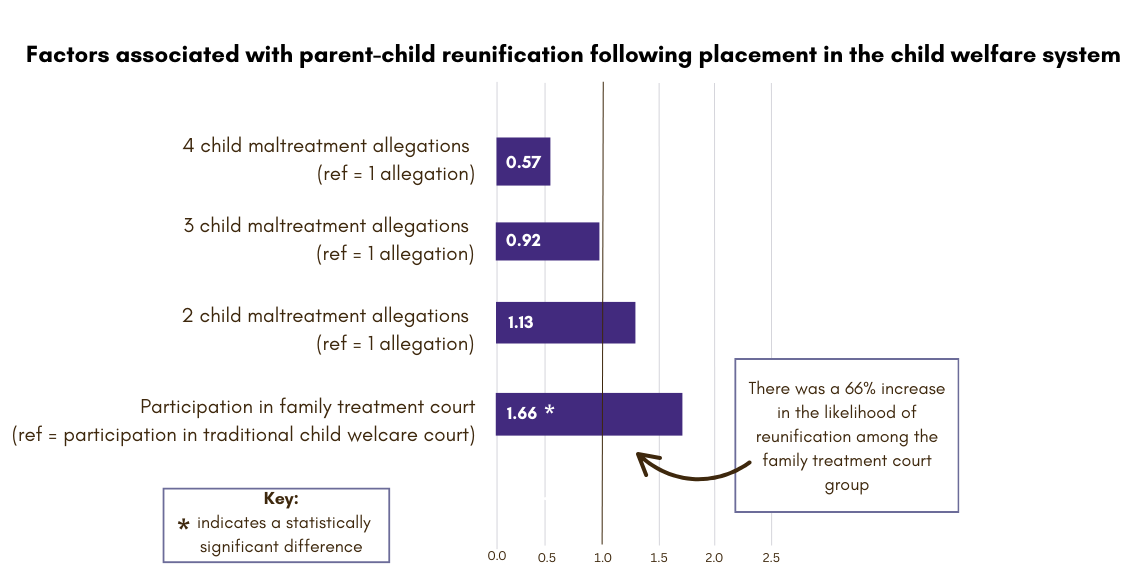
Figure. Factors associated parent-child reunification following placement in the child welfare system. Adapted from Sieger et al. (2025). Click image to enlarge.
Why do these findings matter?
These findings support the idea that participation in family treatment courts promotes family reunification. Although this evidence might be helpful in promoting family treatment courts and improving outcomes, it is also important to remember that White parents were overrepresented in family treatment courts. Racial disparities in referrals and entries into family treatment courts must be addressed. Although the researchers suspected that substance use treatment accounted for the favorable effects of family treatment courts, comprehensive case management and wraparound family services (e.g., childcare, food services, transportation) embedded into family treatment courts might instead have promoted reunification, by improving family health and child safety.
Every study has limitations. What are the limitations in this study?
Families were not randomized to family treatment courts versus child welfare courts. As a result, they differed in important ways, such as race and substance misuse histories, that could have influenced the results. The researchers used statistical procedures to control for these differences, but some unmeasured variables might still have affected the results.
For more information:
Advocates in some U.S. states are seeking funding to expand their family treatment court programs (see West Virginia for an example). Readers might want to explore the state of these programs and advocacy in their own states. For additional substance misuse resources and tools, please visit the BASIS Addiction Resources page.
–Heather Gray, PhD
Want CE credit for reading BASIS articles? Click here to visit our Courses Website and access our free online courses.