




Mourning the loss of a loved one is especially painful when one’s loved one has died by suicide. Many suicide loss survivors are haunted by guilt, endlesslessly questioning what more they could have done to keep their loved one alive. Feeling angry toward the person who died, as well as shame about those angry feelings and the stigma attached to suicide, are also common in the grief process. This week, STASH reviews a study by William Feigelman and colleagues that explored the possibility that suicide-bereaved adults report more problematic substance use than others, potentially as a coping mechanim.
What were the research questions?
(1) Compared to a general population sample, do suicide-bereaved adults report more problematic substance use? (2) Among suicide-bereaved adults, what is the relationship between problematic substance use and grief difficulties?
What did the researchers do?
The researchers surveyed 1,132 U.S. adults who were part of the American Population Panel and reported (1) knowing one or more people who died by suicide during their lifetime, (2) that the person’s death caused moderate to severe emotional distress, and (3) that the suicide occurred during the last six years. Participants answered questions about grief difficulties, self-blaming, PTSD symptoms, depression, and substance misuse. The researchers compared the participants’ substance misuse answers with trends from the 2022 National Surveys of Drug Use and Health survey of 70,000+ nationally representative respondents.
What did they find?
Suicide-bereaved adults were more likely than the nationally representative sample to report consuming marijuana (27% as compared to 14%), drinking alcohol socially (76% as compared with 53%), and smoking cigarettes (21% as compared to 17%) in the past year. However, they were not more likely to report binge drinking and using non-prescribed drugs.
When the researchers looked just at suicide-bereaved adults, they found that indicators of complicated grief, such as PTSD severity and self-blame, were higher among those who reported past-year binge drinking and non-prescribed drug use, compared to their counterparts (see Figure). Further analyses revealed that several of these differences remained after the researchers controlled for a variety of variables, such as years since the loss and closeness to the deceased.
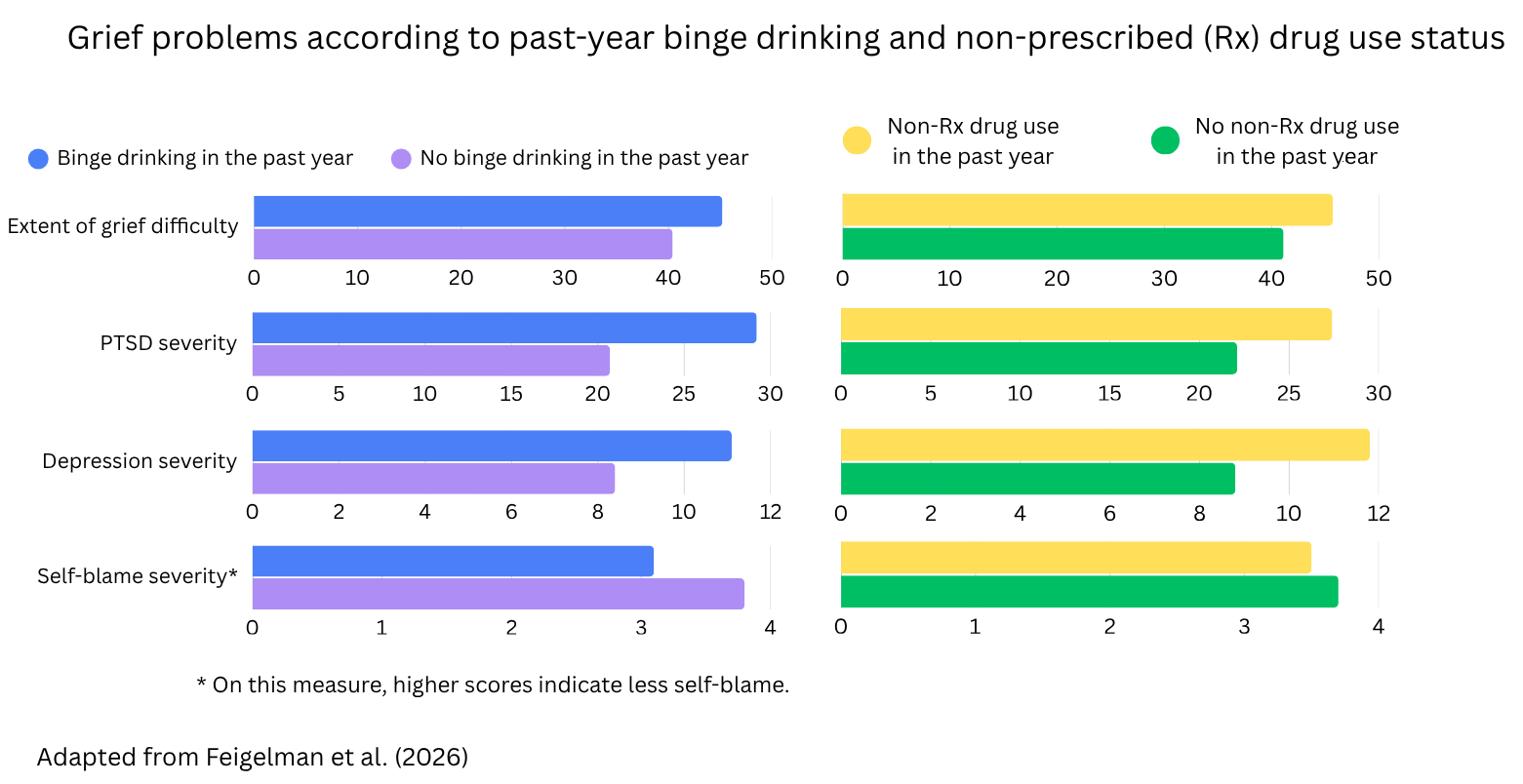
Figure. Mean scores on measures of grief problems as a function of past-year binge drinking and non-prescribed drug use status, among suicide-bereaved adults. All differences were statistically significant except self-blame among those who did, vs. did not, use non-prescribed drugs in the past year. Click image to enlarge.
Why do these findings matter?
The overall pattern of results, combined with what we already know about substance use as a coping mechanism, suggests that people who lose loved ones to suicide might use substances to self-medicate their painful and complicated feelings. Another possibility is that repeated substance misuse makes it harder for people to work through the grief process. Clinicians who treat bereaved people might consider providing psychoeducation about the link between grief and substance misuse, and the consequences of escalating substance misuse, as part of a holistic approach. This is also a topic that people in bereavement support groups might want to discuss.
Every study has limitations. What are the limitations in this study?
The study participants were not matched in terms of demographics with the nationally representative sample, so, factors such as age and gender composition could have partially accounted for the differences in substance misuse rates.
For more information:
The American Foundation for Suicide Prevention provides resources for people coping with a loved one’s suicide, including videos, stories about loss, and links to support groups. Their page can be found here. Visit our Addiction Resources page for additional information and resources on substance use.
– Heather Gray, PhD
Want CE credit for reading BASIS articles? Click here to visit our Courses Website and access our free online courses.