




Although fewer Americans are drinking now than in recent decades, alcohol use remains common among older adults. In 2024, an estimated 2.9 million U.S. adults aged 65+ met the criteria for an alcohol use disorder. One-third of older adults with problematic drinking develop these behaviors later in life, a pattern known as late-onset drinking. This week, The DRAM reviews a study by Kevin McInerney and colleagues that investigated psychosocial factors that contribute to the development of late-onset problematic alcohol use.
What was the research question?
What psychosocial factors contribute to the development of early-onset versus late-onset problematic drinking?
What did the researchers do?
The researchers recruited 18 adults aged 50 and older, most of whom lived in the UK. All participants were in recovery from problematic drinking and were recruited through recovery-focused organizations. Half of the participants developed alcohol problems earlier in life, while the other half experienced late-onset problematic drinking1. Participants completed semi-structured interviews about their drinking histories and experiences prior to recovery. The researchers used interpretative phenomenological analysis to explore how participants made sense of their experiences in order to identify common psychosocial factors that contributed to early-onset and late-onset problematic drinking.
What did they find?
Most of the early-onset participants had difficulty managing their emotions and turned to alcohol at a young age to cope with feelings like social anxiety or low self-esteem (see Figure). Many of them described a reciprocal family dynamic in which growing up around alcohol problems shaped their own drinking and, in turn, their drinking later impacted their family. Their drinking escalated quickly, and many described suddenly losing control. In contrast, late-onset participants drank socially for most of their lives, but more frequent alcohol use gradually became a problem. This escalation often followed a major life event that disrupted their sense of purpose and identity, most commonly changes to employment. Nearly all participants in both groups had co-existing mental health challenges, like depression, and used drinking as a way to manage the discomfort they felt as a result of these challenges.
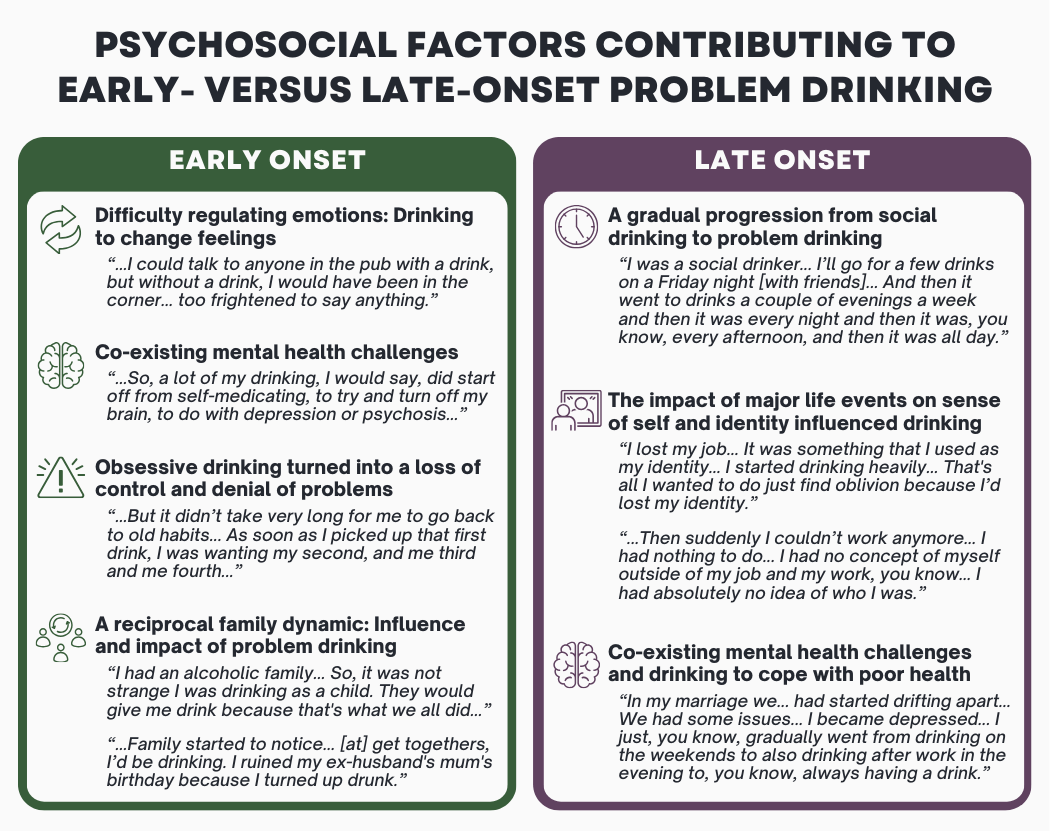
Figure. Psychosocial factors contributing to early- versus late-onset problem drinking, from narrative experiences of older adults in recovery. Quotes from participants illustrate each factor. Click image to enlarge.
Why do these findings matter?
Alcohol misuse in later life can have serious consequences but is often under-detected. As the population ages, understanding why some older adults develop problematic drinking is important for informing prevention and intervention efforts. This study’s findings support the idea that late-onset alcohol problems often emerge in response to major life transitions associated with aging. Older adults may benefit from resources that provide guidance and support in navigating experiences like retirement or bereavement. Healthcare providers should consider routine screening for alcohol misuse, mental health concerns, and life stressors. Integrated interventions that address problematic alcohol use alongside co-occurring mental health issues can help older adults reduce their drinking and maintain abstinence.
Every study has limitations. What are the limitations in this study?
Each group in this study had a small sample size (n = 9). This is typical for interpretive phenomenological analysis, which is intended for in-depth exploration of individual experiences and identifying common patterns, rather than broad generalizations. Most of the participants had a high socioeconomic status, which could indicate selection bias. This also means the findings may not represent the experiences of older adults with different economic circumstances. The study was retrospective, so results may be influenced by recall bias.
For more information:
The National Institute on Aging provides information and resources about aging and alcohol use. Visit the National Institute on Alcohol Abuse and Alcoholism for tips and resources for people struggling with problem drinking. For additional information and drinking self-help tools, please visit our Addiction Resources page.
— Kira Landauer, MPH
Want CE credit for reading BASIS articles? Click here to visit our Courses Website and access our free online courses.
________________
1. For the early-onset group, most participants (n = 6) developed problematic alcohol use before age 30, while the rest were in their 30s when drinking became a problem. In the late-onset group, most (n = 6) were between ages 45 and 50 when their drinking became problematic, while the rest were in their 50s.