




Sports culture within the U.S. is deeply intertwined with substance use, in particular alcohol use. As sports gambling is legalized in more states, however, public health advocates have raised concerns about health implications. This is especially concerning when one considers the recent posturing of gambling as an important part of sports fandom. As this sports gambling culture grows, it is important to understand how it interacts with and relates to pre-existing drinking habits. This week, as part of our Special Series in Honor of Dr. Howard Shaffer, The DRAM reviews a study by Scott Graupensperger and colleagues that explored the associations between problem sports betting, alcohol use, and negative consequences.
What was the research question?
How does problematic sports gambling relate to risky alcohol consumption?
What did the researchers do?
The researchers recruited a sample of 221 U.S. based young adults ages 18 to 29 who had bet on sports at least twice in the past month and asked them to complete a brief online survey that included three scales. One was a modified version of the Problem Gambling Severity Index (PGSI) that specifically referenced sports gambling and its consequences. The other two scales related to alcohol. The first, the Alcohol Use Disorder Identification Test (AUDIT) measured hazardous alcohol use. The second, the Brief Young Adult Alcohol Consequences Questionnaire (BYAACQ), measured participants’ negative consequences from alcohol use. The researchers used logistic regression and negative binomial models to study relationships between PGSI scores and AUDIT and BYAACQ scores.
What did they find?
On average, participants scored relatively low on the PGSI (i.e., 4.9 out of 27, which equates to low-to-moderate risk) and the AUDIT (i.e., 6.4 which equates to low-risk use). Despite this, the researchers found that problematic sports betting was associated with higher scores on the AUDIT. Similarly, problematic sports betting severity also predicted alcohol-related consequences. Moderation analyses also revealed that both of these relationships were stronger among those who reported more days where they both consumed alcohol and bet on sports (see Figure).
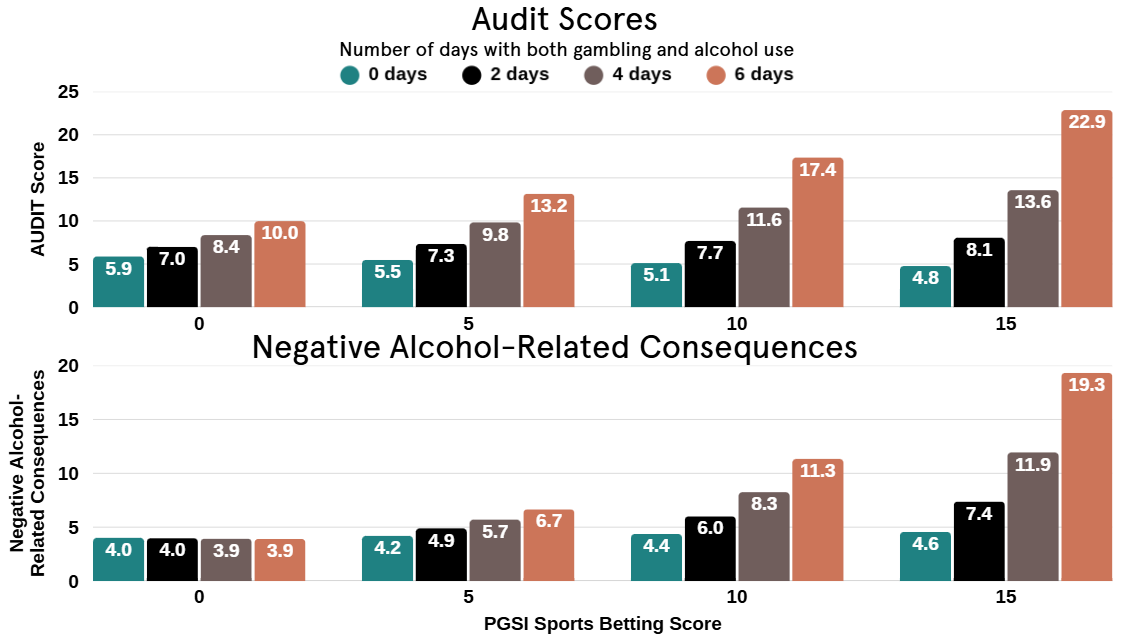
Figure. Displays the estimated mean AUDIT scores (top panel) and the number of negative alcohol-related consequences (bottom panel) with respect to Problem Gambling Severity Index (PGSI) scores and number of days with both gambling and alcohol use. Click image to enlarge.
Why do these findings matter?
These findings underscore the need to address addictive issues holistically, focusing on the entire picture. Because this study found that more frequent co-use is related to stronger correlations between problem gambling and problematic alcohol use, it is likely that reducing this frequency can reduce the severity of both problems. Interventions that target these comorbid behaviors, such as the ones outlined by John Cunningham and colleagues, may be especially effective.
Every study has limitations. What are the limitations in this study?
This study was limited to cross-sectional data which prevented any analyses focused on the temporal relationship between problem sports betting and alcohol use. Furthermore, this study collected data between June and November and does not include data on periods where sports betting is more prevalent (e.g., NFL playoffs/March Madness).
For more information:
Individuals who are concerned about their gambling behavior may benefit from visiting Gamblers Anonymous. Others who are concerned about their drinking may benefit from engaging with Alcoholics Anonymous. Additional resources can be found at our Addiction Resources page.
—John Slabczynski
Want CE credit for reading BASIS articles? Click here to visit our Courses Website and access our free online courses.