




Family members can sometimes play a vital role in preventing their loved ones who use drugs from accidentally overdosing. They can also provide critical ongoing support, such as by offering emotional care or accompanying their loved ones to treatment. However, these responsibilities, combined with other stressors including the stigma attached to addiction, can create a heavy burden. This week, as part of our Special Series on Addiction and Affected Others, STASH reviews a study by Saranee Fernando and colleagues that explored family carers’ experiences of stress and support.
What was the research question?
What are substance-affected family carers’ experiences of stress and support?
What did the researchers do?
The context for this study was British Columbia’s epidemic of overdose deaths due to fentanyl analogues in the late 2010s and early 2020s. Between August 2020 and August 2021, the researchers interviewed 22 family members and friends of people who use or used drugs. Most loved ones continued to be at risk of overdose, but some had died. The interview questions concerned the relationship between the family carer and their loved one at risk of overdose, interactions with systems available for addressing the overdose crisis, supports used by the family carer, and more. The researchers used reflexive thematic analysis to identify themes that emerged from the interviews.
What did they find?
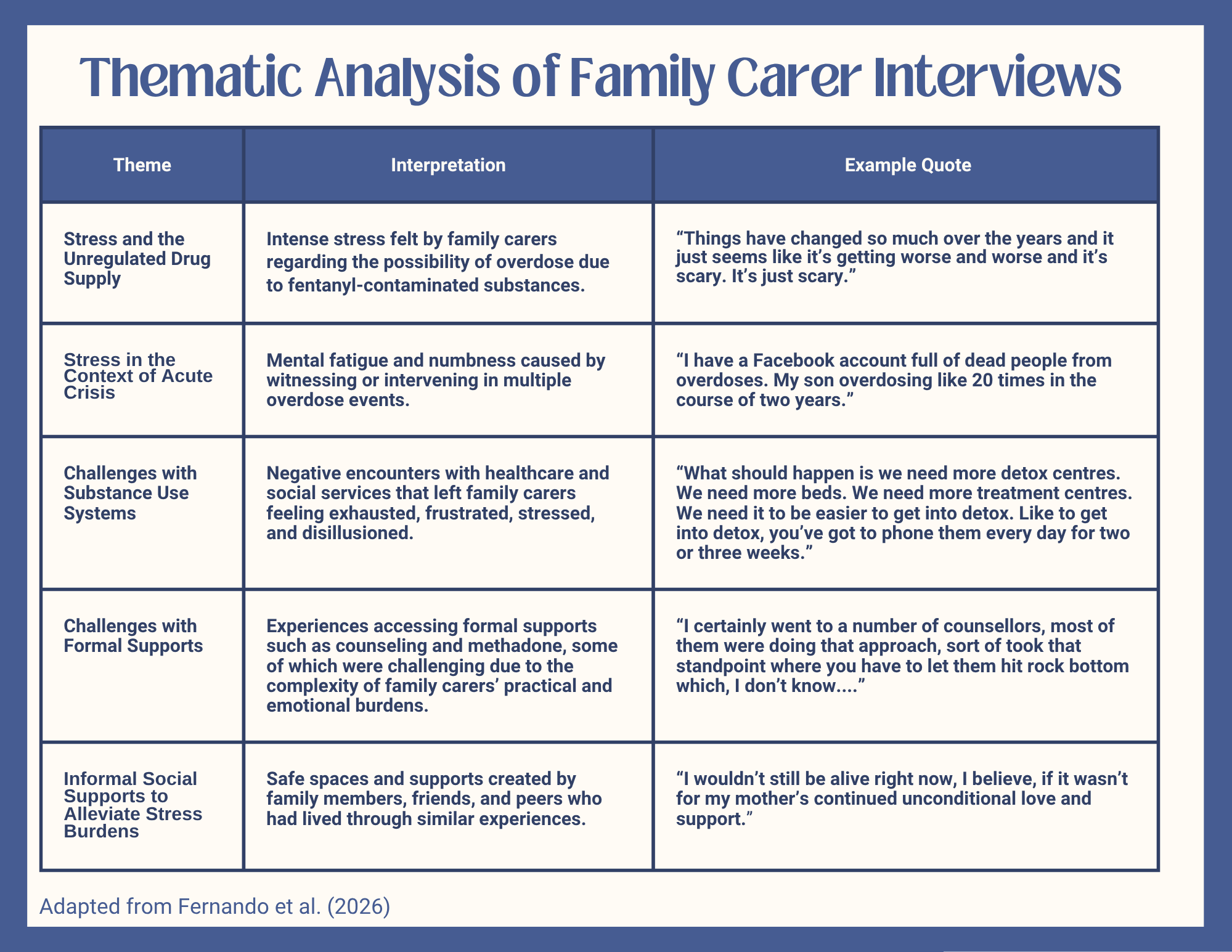
The researchers generated five themes reflecting participants’ experiences of stress and support (see Figure).
- The first theme, Stress and the Unregulated Drug Supply, reflected intense stress felt by family carers regarding the possibility of overdose due to fentanyl-contaminated substances.
- The second theme, Stress in the Context of Acute Crisis, highlighted the ripple effects of witnessing or intervening in multiple overdose events, which created mental fatigue and numbness.
- The third theme, Challenges with Substance Use Systems, concerned family carers’ negative encounters with healthcare and social services. Parents and spouses, in particular, reported feeling exhausted, frustrated, stressed, and disillusioned by the scarcity of services.
- The fourth theme, Challenges with Formal Supports, expressed participants’ experiences accessing formal supports. Some support professionals did not seem to grasp the complexity of family carers’ practical and emotional burdens.
- Finally, the theme Informal Social Supports to Alleviate Stress Burdens described the safe spaces and supports created by family members, friends, and peers in recovery who had lived through similar experiences.
Why do these findings matter?
This research indicates that fear of a loved one’s overdose permeates the daily life of loved ones. Other research tells us that this kind of chronic stress can lead to poor health. Interventions and policies should bolster family carers’ resilience by providing emotional, material, informational support. For example, the Community Reinforcement and Family Training (CRAFT) program teaches family carers ways to communicate with and support their loved ones who use drugs while also taking care of themselves.
Every study has limitations. What are the limitations in this study?
As is typical in qualitative research, this study involved a small sample. Participants’ experiences might not have been representative of the larger population of substance-affected family carers.
For more information:
The Recovery Research Institute at Massachusetts General Hospital offers a webpage with resources for substance-affected family carers. Visit our Addiction Resources page for additional information and resources on substance use.
– Heather Gray, PhD
Want CE credit for reading BASIS articles? Click here to visit our Courses Website and access our free online courses.