




Despite the availability of effective treatments, many people with substance use disorders (SUD) do not receive care. Programs that regularly interact with people who use drugs can help bridge this gap. For example, syringe services programs provide safer use supplies and offer referrals to treatment, while the criminal legal system can connect individuals to care during touchpoints such as arrest, incarceration, or sentencing. This week, STASH reviews a study by Leslie W. Suen and colleagues that examined how syringe services program use and criminal legal system involvement relate to recent SUD treatment among people who use drugs.
What was the research question?
Is recent SUD treatment associated with recent syringe services program use or criminal legal system involvement among people who use drugs?
What did the researchers do?
The researchers surveyed 770 adults who had used drugs in the past 30 days, recruited from locations in San Francisco where people who use drugs spend time.1 Participants reported their past 3-month engagement with syringe services programs, the criminal legal system2, and SUD treatment. The researchers used descriptive statistics to summarize these experiences and Poisson regression to examine whether recent involvement with syringe services programs or the criminal legal system was associated with recent SUD treatment.
What did they find?
Most participants (78%) had recently used a syringe services program, and nearly half (48%) had recent contact with the criminal legal system, most often through police stops. Around a quarter (27%) had received SUD treatment, most commonly medications or outpatient services, including peer support and care from medical providers. Controlling for other factors, participants who recently used syringe services programs were more likely to have received SUD treatment in the past three months, while criminal legal system involvement was not associated with treatment (see Figure).
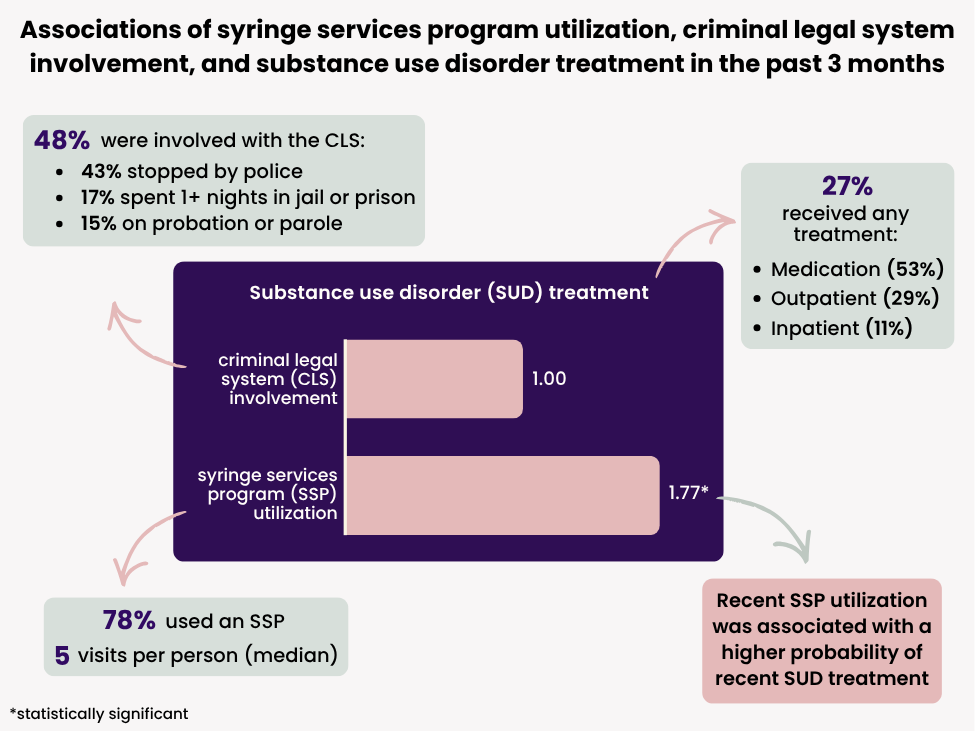
Figure. Associations of syringe services program utilization, criminal legal system involvement, and substance use disorder treatment in the past 3 months. Click image to enlarge.
Why do these findings matter?
This study found that people who had recently used a syringe services program had a higher probability of recent SUD treatment, reinforcing that these programs might be an important link to care for people who use drugs and highlighting the importance of strengthening these programs. Although criminal legal system involvement was not associated with recent SUD treatment, this does not mean that referral systems in these settings are without value. Strengthening connections at legal system touchpoints is especially important given the heightened risk of overdose following incarceration.
Every study has limitations. What are the limitations of this study?
This was a cross-sectional study, so we don’t know whether engagement with syringe services programs or the criminal legal system happened before or after SUD treatment. As a result, we can’t determine the direction of the relationships or whether one experience influenced the other. This study used self-report measures, which are subject to social desirability and recall bias. Finally, participants were asked only about the most common types of criminal legal system contact, so other potential referral points may not have been captured.
For more information:
If you are worried that you or someone you know is experiencing addiction, the SAMHSA National Helpline is a free treatment and information service available 24/7. For additional general resources and tools, please visit the BASIS Addiction Resources page.
— Kira Landauer, MPH
Want CE credit for reading BASIS articles? Click here to visit our Courses Website and access our free online courses.
________________
1. Participants were recruited from street settings, unhoused communities, and social service programs (like food banks). Participants were not recruited from syringe services programs, prisons/jails, or SUD treatment providers.
2. Criminal legal system involvement was defined as (1) stopped by the police, (2) spent a night in jail or prison, and/or (3) being on probation or parole. These were selected because they are the most common of many touchpoints with the criminal legal system.