




In today’s society, gambling advertising is continually growing and can be found everywhere. Some consumer segments, like young people, might be more susceptible to gambling advertising. As such, they are often the targets of these ad campaigns. This week, The WAGER reviews a study by Samantha Tessier and colleagues that examined the impact of gambling advertising on gamblers in France, with a focus on discovering groups that might be especially susceptible to the impact of ads.
What were the research questions?
(1) How does gambling advertising influence gamblers’ behavior? and (2) What personal characteristics and gambling behaviors predict gamblers’ reactions to gambling ads?
What did the researchers do?
The French gambling operator, Française de Jeux, invited 15,000 randomly-selected active adult subscribers to participate in the study in February 2021. Only subscribers who had gambled in the past year were eligible. Participants completed measures of demographics (e.g., age), gambling-related variables (e.g., problem gambling severity) and other possible predictors of responses to the ads. Then, they viewed 10 nationally-broadcast ad campaigns that had been displayed in 2020 by the five largest legal gambling operators in France. They then self-reported their recall of the posters and whether the posters motivated or actually led them to gamble within 48 hours of exposure. Only participants who could recall having seen any of the ad campaigns were included in the analyses. The final sample included 1,334 participants. The researchers conducted logistic regression analyses to test the association between predictor variables and gambling behaviors post-ad exposure. They conducted one analysis each for demographics variables and gambling-related variables.1
What did they find?
Participants, on average, recalled having seen 2.5 out of 10 ads, with about one third (36%) reporting that they felt motivated to gamble and over one fifth (22%) reporting that they actually gambled within 48 hours after viewing at least one ad. Playing more types of games, having greater problem gambling severity, gambling in person (vs. only digitally), and having greater internet gaming disorder severity predicted self-reported motivation to gamble after seeing ads (see Figure). Playing more games and greater problem gambling severity also predicted engaging in gambling after seeing ads. Beyond gambling characteristics, younger age was a noteworthy demographic predictor of being influenced by the ads.
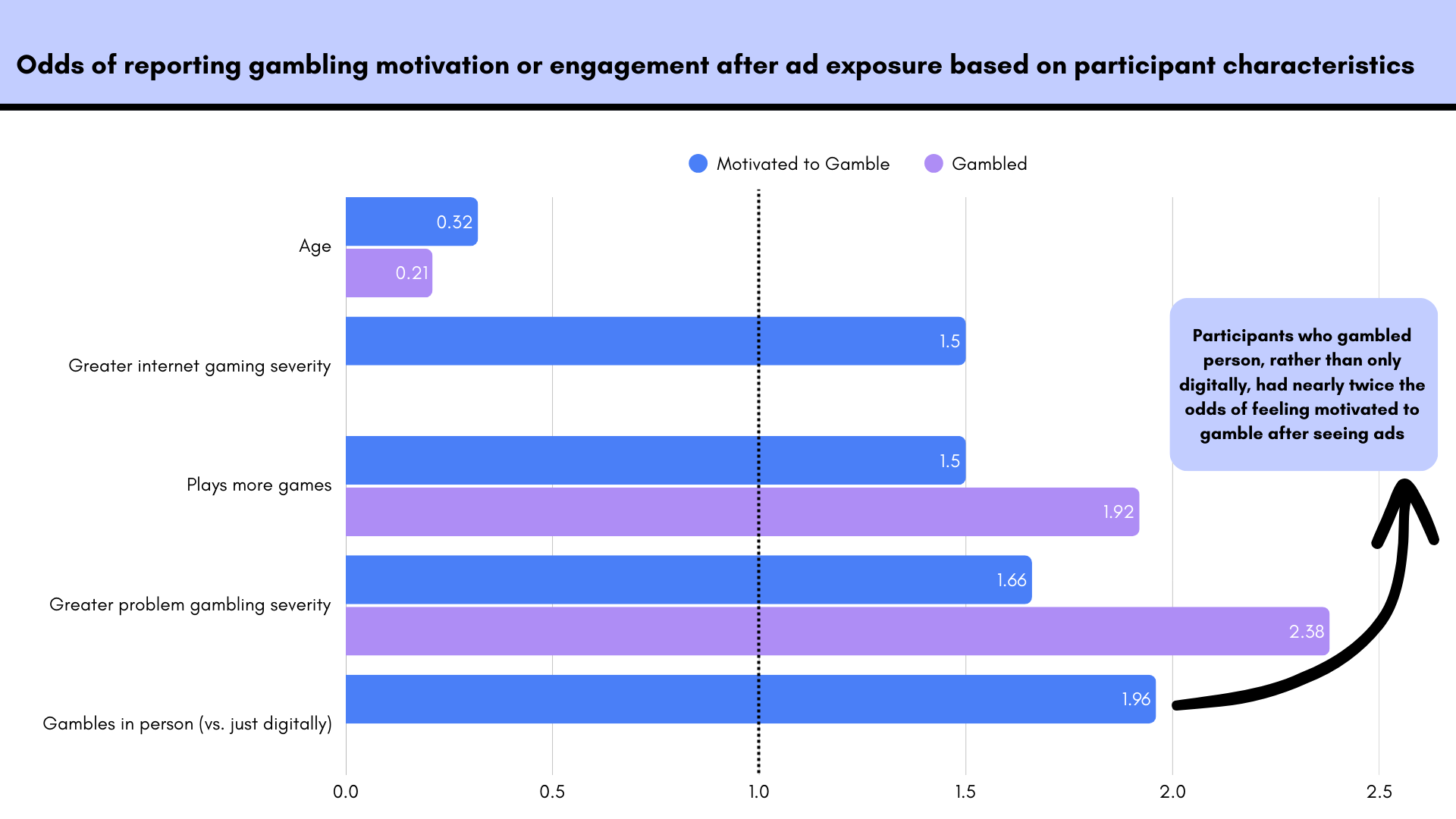
Figure. Adjusted odds ratios showing the effect of each predictor variable on self-reported motivation to gamble and actual gambling after viewing gambling ads. The odds ratios reflect the adjusted effects while controlling for predictors within each category (demographics and gambling-related variables). Only statistically significant results are included. Click image to enlarge.
Why do these findings matter?
These findings give insight into the impact of gambling advertising on vulnerable populations like people with gambling problems. They also highlight the characteristics that might be important to focus on when designing interventions or future research. This study suggests that regulatory actions that limit exposure to gambling ads in daily life might especially benefit those who are already vulnerable. It is important also for schools, healthcare institutions, and the gambling industry to take action and develop independent policies or interventions that minimize problem gambling risk in their respective communities.
Every study has limitations. What are the limitations in the study?
This study relied on self-report data which can be subject to recall or social desirability bias. The use of a cross-sectional study design is unable to confirm causality between ad exposure and any gambling behaviors. As the study is set in France, it may not be generalizable to other countries with differing gambling markets or regulations on advertising.
For more information:
If you or someone you know has a gambling problem, please visit the National Council on Problem Gambling or Gamblers Anonymous for screening tools and resources to learn more. Additional resources on gambling can be found on the BASIS Addiction Resources page.
— Justin Huynh, MPH
________________
1. Analyses of other variables are not reported here.