ASHES, Vol. 22(7) – Daily patterns of nicotine and cannabis vape co-use
As new innovations from the tobacco industry such as e-cigarettes enter the market, public health advocates have started raising concerns. Many point to the high prevalence of vaping among youth and young adults who were otherwise “tobacco-naive” as evidence that a new generation is developing an addiction to nicotine. Beyond aggressive marketing campaigns, these products present new challenges such as unique use patterns compared to traditional cigarettes. More recently, cannabis vapes have entered the market, further complicating treatment and prevention efforts. This week, as part of our Special Series on Addiction Among Emerging Adults, ASHES reviews a study by Deanna Halliday and colleagues that explored the daily nicotine and cannabis use patterns of young adults who vape.
What was the research question?
What are the usage and co-usage patterns of nicotine and cannabis vapes among young adults who vape?
What did the researchers do?
The researchers recruited 113 California-based young adults (ages 18-29) using social media ads. They only included those reporting vape use on at least 20 days in the past month who intended to quit vaping within six months. At baseline, participants indicated their demographics, substance use, mental health, and current vaping behaviors. For the following 30 days, they completed daily diaries in the evening detailing their vape use throughout the day in addition to ecological momentary assessments throughout the day. Using these data, the researchers then classified daily use patterns using multilevel latent class analysis. This technique treated “days” (of daily diary reports) as the main unit of analysis, not the participants.
What did they find?
The researchers identified three distinct classes of product use. Class 1 (52.7% of days) were days with a high likelihood of nicotine vaping and a low likelihood of using other products. Class 2 (39.9% of days) were days when nicotine and cannabis vaping were more common compared to other product use. Class 3 (7.4% of days) were days where combustible cannabis and nicotine products were used at a higher rate while vaping was less common. Interestingly, the use of other tobacco products (e.g., smokeless tobacco) was rare across all three classes of days. (See Figure).
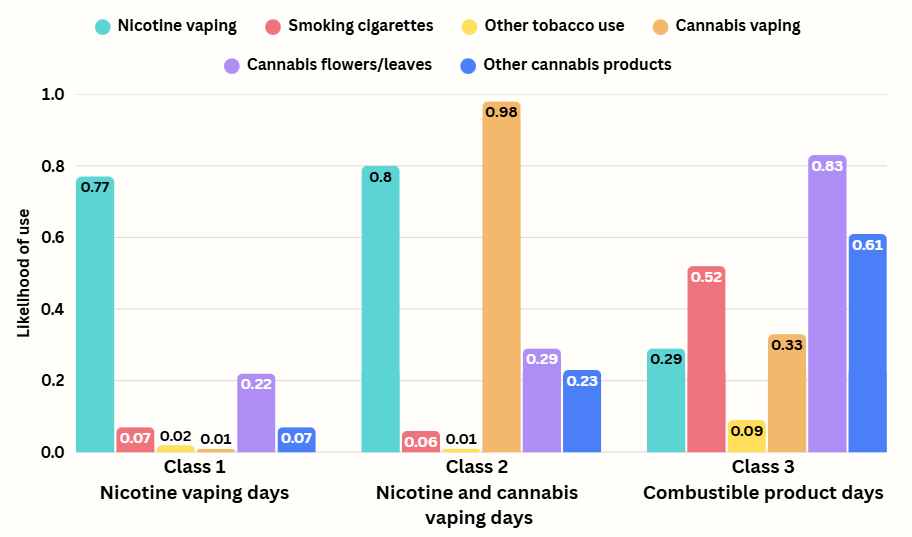
Figure: Displays the likelihood of using specific substances, as a function of the classes of days (specifically, the conditional probability of endorsing substance use on a day assigned to a class). Click image to enlarge.
Why do these findings matter?
These findings are important for individuals and treatment professionals because polysubstance use, such as the co-use of nicotine and cannabis, complicates treatment efforts. For example, the co-use of cannabis and tobacco can make it more difficult to stop using either substance. Similarly, treatment professionals should consider ways to help clients avoid compensatory use or substitution. Fortunately, the results suggest that young adults are unlikely to switch to other tobacco products (e.g., nicotine pouches), at least for now.
Every study has limitations. What are the limitations in this study?
Only people who intended to quit vaping were included. This likely biased the sample towards individuals who hold more negative views about vaping. Similarly, this study took place in California, where cannabis is legal and largely accessible. Therefore, these results may not be generalizable to other places where cannabis is regulated differently.
For more information
Individuals who are concerned about their nicotine use may benefit from visiting smokefree.gov. Others who are concerned about marijuana use may benefit from engaging with Marijuana Anonymous. Additional resources can be found at the BASIS Addiction Resources page.
—John Slabczynski
Want CE credit for reading BASIS articles? Click here to visit our Courses Website and access our free online courses.