




Gambling can create financial, social, psychological, and physical harms. Of particular concern is suicidality, which recent research has identified as a potential gambling harm. As we undergo worldwide gambling expansion, it is imperative that public health experts and the gamblers themselves know more about this link, including whether problem gambling predicts future suicidality. This week The WAGER reviews a study by Oliver Bastiani and colleagues that explored the relationship between problem gambling and suicidality among the same participants over time.
What were the research questions?
Do gambling problems predict future suicidality?
What did the researchers do?
The researchers used data from the Avon Longitudinal Study of Parents and Children, a United Kingdom-based birth cohort study. They limited their analysis to data collected from 2,801 participants who completed assessments between the ages of 16 and 25. During these years, participants provided information on their suicidality and gambling problems. The researchers used logistic regression to examine whether having gambling problems at age 20 or 24 increased the odds of reporting past-year suicide attempts at age 24 or 25, controlling for some known risk factors such as sex, alcohol consumption/harms, and previous suicide attempts.
What did they find?
Most participants reported no problem gambling at both age 20 (70.4%) and age 24 (76.5%). Approximately 2.6% reported a past-year suicide attempt at age 24 and 1.9% did so at age 251. Problem gambling severity at age 24 was associated with increased odds of past-year suicide attempt at the same age. Longitudinal analyses revealed that problem gambling at age 20 was predictive of past-year suicide attempts at age 24 but not at age 25. On a shorter timespan, problem gambling at age 24 predicted past-year suicide attempts at age 25. (See Figure.)
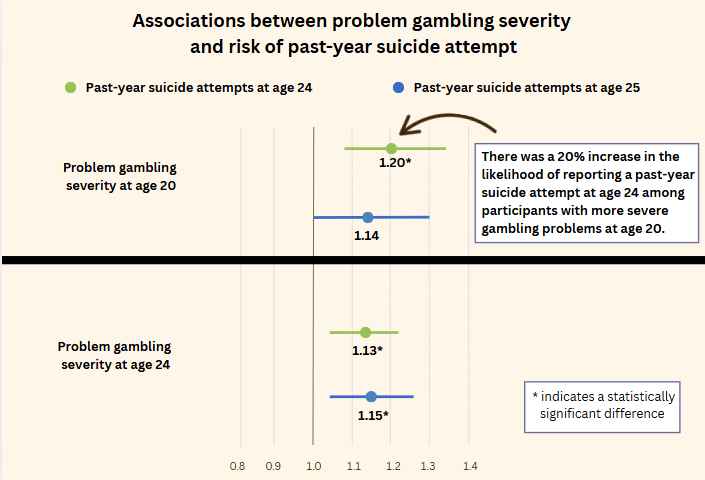
Figure. Displays the odds of reporting past year suicidality at ages 24 and 25 by problem gambling severity at ages 20 and 24. Odds ratios can be interpreted as having X times higher odds of reporting an event. For example, a one-point increase in problem gambling severity (e.g., answering “most of the time” instead of “sometimes” on one question) at age 24 was associated with having 1.13 times higher odds of reporting past year suicidality at age 24.
Why do these findings matter?
These findings provide more support for the idea that problem gambling contributes to future suicidality, because in this study, problem gambling preceded suicide attempts. Because problem gambling can be detected and managed at an early stage, it is essential to spread the word about brief gambling screening to healthcare providers and anyone else in a position to intervene, such as college health services staff and debt counselors. Furthermore, public health advocates can use this information to more effectively advocate for preventive tools like mandatory cool-off periods, which can disrupt gambling flow states and discourage long sessions, or tighter regulations on gambling and gambling advertising.
Every study has limitations. What are the limitations in this study?
The relationship between problem gambling and suicidality is probably more complicated than a single study can reveal. For instance, this study did not explore the possibility that suicidality predicted future problem gambling (i.e., reverse causality), which might happen if people develop gambling problems while trying to escape from painful suicidal thoughts. Another complication is that problem gambling tends to occur alongside depression, anxiety, and illicit drug use, which the researchers were unable to control for, and which might have partly accounted for the relationships with suicide attempts.
For more information:
Individuals who are concerned they may harm themselves should engage with the Suicide Prevention Resource Center. Others who are concerned about their gambling may benefit from engaging with the National Council on Problem Gambling’s treatment locator. Additional resources are available on our Addiction Resources page.
— John Slabczynski
Want CE credit for reading BASIS articles? Click here to visit our Courses Website and access our free online courses.
________________
1. This study used multiple measures of suicidality. The researchers first asked participants at age 16 if they had ever attempted suicide. At ages 24 and 25, participants also indicated whether they had a attempted suicide in the past year.