




As legalized sports betting grows in popularity, public health experts have raised concerns about its potential harms. As advertisers and sports leagues continue to make gambling a key part of spectatorship, this could normalize betting as a natural part of sports fandom. Previous research suggests that these practices are contributing to an increase in gambling problems, particularly among young adults. To better address these concerns, public health advocates need to understand the specific problems associated with young adult sports betting. This week, The WAGER reviews a study by Nerilee Hing and colleagues that explored young adult sports bettors’ experiences of gambling harm and their perspectives on changing their gambling behavior.
What were the research questions?
(1) How do young adult sports bettors experience gambling harms? (2) How do they conceptualize and engage in changing harmful gambling?
What did the researchers do?
The researchers recruited 50 Australians between the ages of 18 and 25 who reported experiencing moderate or severe harm from sports betting in the past year. Participants completed interviews with the research team that asked about the nature of sports betting-related harms they experienced, perceived barriers and facilitators of gambling behavior change, and strategies they used to change their gambling. The researchers then coded the transcribed interviews to identify relevant themes.
What did they find?
The interviews revealed five distinct types of sports betting-related harm: 1) financial harm, 2) harm to mental health, 3) harm to work or study, 4) relationship harm, and 5) harm to physical health. Participants reported that many of these harms built up over time and intersected with one another. For example, several participants indicated that financial harms grew over time, and that these harms worsened their mental health. At the time of interviews, some participants were unwilling to change their gambling behavior. Others, however, pointed to improved knowledge of gambling disorder and an awareness of gambling harms as key factors in choosing to change their harmful behavior (see Figure).
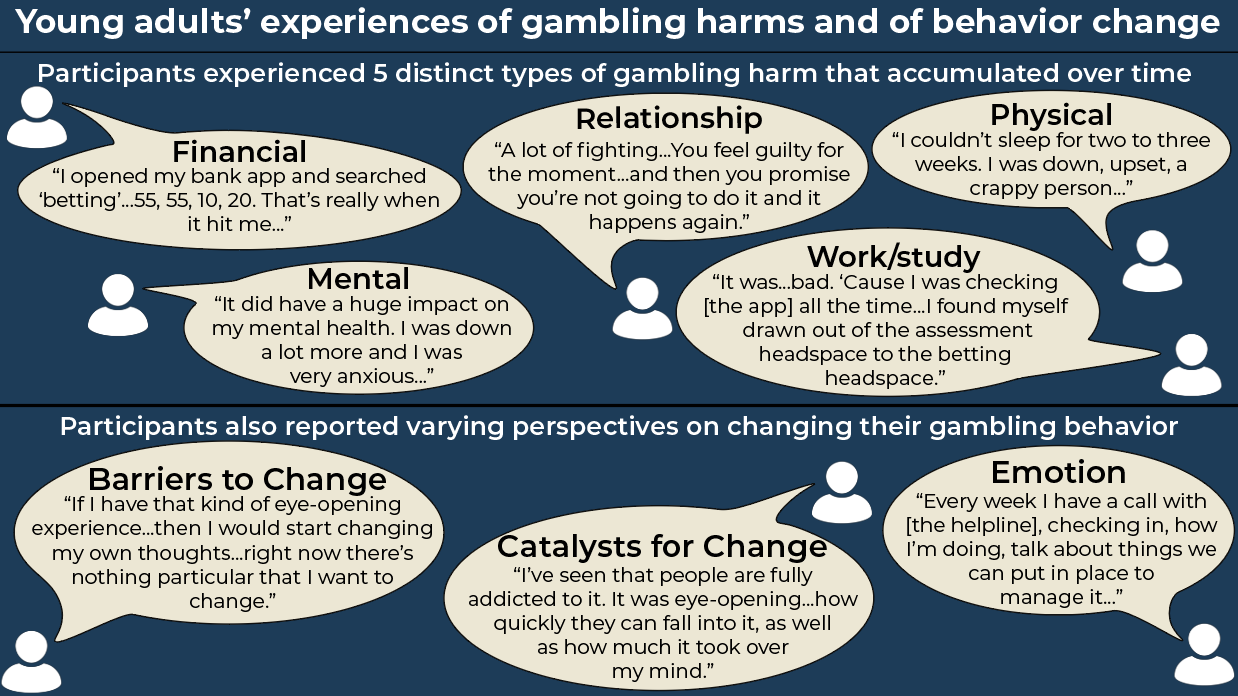
Figure. Displays participant quotes representing each theme identified through thematic analysis. Click image to enlarge.
Why do these findings matter?
Information on the types of harm experienced by young adult sports gamblers can help public health practitioners identify potential gambling problems quickly and accurately, allowing for timely intervention and support before more significant harms happen. This study’s findings on behavior change are especially important. Many participants emphasized the value of awareness of gambling as an addiction as a catalyst for behavior change. Initiatives such as The Faces of Gambling that highlight how gambling problems develop from the perspective of people with lived experience may be especially effective in reducing the prevalence of gambling harms.
Every study has limitations. What are the limitations in this study?
This study screened participants for a history of experiencing gambling harms using a list of previously researched harms, which may have primed the sample to report these very same types of harm. Similarly, because the study focused on moderate to severe cases of gambling disorder among young adults, the results of this study may not be generalizable to those who experience less severe forms of the condition, or the wider gambling population.
For more information:
Those concerned about their gambling can find support on the National Council on Problem Gambling’s treatment resources page. Individuals looking to change their gambling behavior may also benefit from Gamblers Anonymous. Additional resources are available on our Addiction Resources page.
— John Slabczynski
Want CE credit for reading BASIS articles? Click here to visit our Courses Website and access our free online courses.