The WAGER, Vol. 31(12) – Do different types of affected others manage gambling harms differently?
According to one estimate, one person’s gambling behavior impacts at least six people around them. These affected others (AO) can include parents, partners, siblings, children, friends, colleagues, and the broader community. The burden of harm that AO experience and how they respond might depend on the closeness of their relationship with the gambler and their emotional, financial, and social involvement. This week, as part of our Special Series on Addiction and Affected Others, The WAGER reviews a study by Monique N. Gandhi and colleagues that examined what strategies AO used to lessen the impact of gambling-related harms and determined whether these strategies differed for partners and non-partners.
What were the research questions?
(1) What strategies do AO use to lessen the impact of gambling-related harms, and (2) do these strategies differ between partners and non-partners?
What did the researchers do?
The researchers used secondary data from an Australian study that examined AO experiences of gambling harms. In this original study, the researchers used convenience and snowball sampling to recruit 44 adult AO. Via an online survey, participants reported on their relationship with the gambler. Participants were also interviewed about their experiences as AO – how they supported themselves and the gambler. The researchers of the present study used reflexive thematic analysis to determine how participants managed gambling harms and the differences in responses between partner and non-partner AO. These responses were separated into themes.
What did they find?
Three themes emerged: (1) holding it together; (2) pushing for change and (3) different needs, limited options (see Figure).
- The theme holding it together reflects how AO learned to manage gambling harms, while preserving their well-being. Both groups sought formal/informal social support. Partners found venting to be a cathartic way to process distress, while non-partners more often found relief by creating distance between themselves and the gambler.
- The theme pushing for change reflects the responsibility felt by AO to intervene in their loved one’s gambling. Partners described more direct actions, like setting financial boundaries, and non-partners described more indirect approaches, like suggesting support resources.
- The theme different needs, limited options reflects the type of supports AO perceived to be most impactful for managing gambling harms and barriers to accessing support. Partners preferred supports that acknowledged their needs and provided a space to connect with people with similar experiences. Rather than seeking support for themselves, many non-partners sought support to help the gambler manage their behavior. Support barriers included limited availability and a lack of AO-tailored resources.
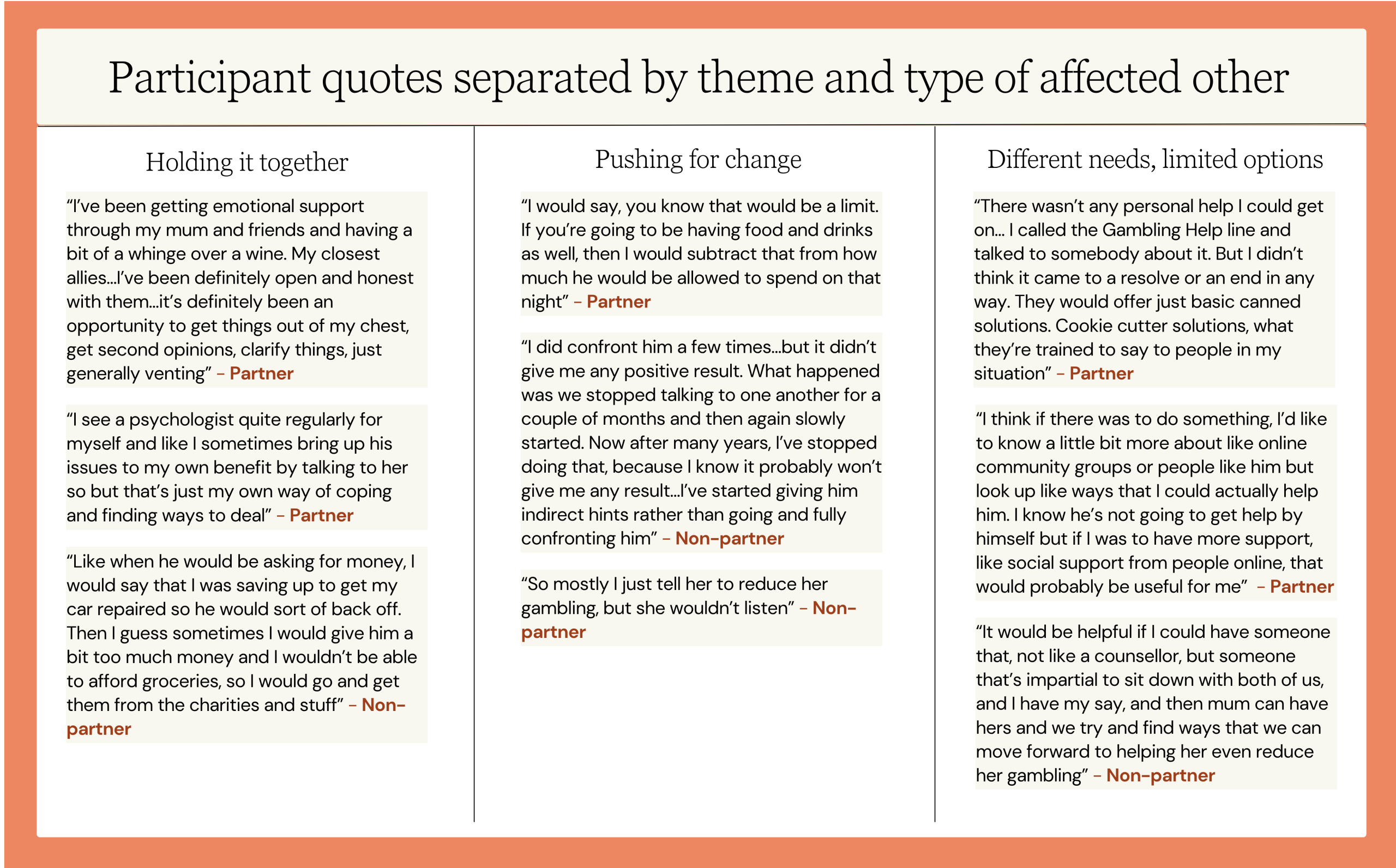
Figure. Themes related to participant interviews, and select quotes from participants separated by theme and type of AO. Adapted from Gandhi et al. (2026). Click image to enlarge.
Why do these findings matter?
Strategies to support AO should be tailored to their needs and relationship with the gambler (see below for resources). Due to their tightly interconnected lives and exposure to harm, partners might benefit from support that targets their financial/emotional distress and offers guidance on how to support their gambling loved one, while maintaining their well-being. Non-partners seem to be better situated to create clear boundaries with their loved one and indirectly encourage them to change their behavior.
Every study has limitations. What are the limitations in this study?
Because the researchers used secondary data for their analysis, the sample was not tailored to the aims of this study. This, and the small sample size, limited their ability to compare how different non-partner AO groups (e.g., parents vs. friends of the gambler) respond to gambling harms and whether they could benefit from individualized supports. Future qualitative research should address this with purposive sampling.
For more information:
Taking Steps for Self-Care: A Problem Gambling Resource for Affected Others is a resource for affected others that offers guidance on prioritizing their needs while navigating a loved one’s gambling – developed by the Massachusetts Department of Public Health’s Office of Problem Gambling Services. Gam-Anon is a support group for individuals affected by a loved one’s gambling. The National Council on Problem Gambling offers resources for people concerned about their gambling. For additional resources, including gambling and self-help tools, visit our Addiction Resources page.
— Nakita Sconsoni, MSW
Want CE credit for reading BASIS articles? Click here to visit our Courses Website and access our free online courses.