The DRAM, Vol. 22(11) – Al-Anon participation among people affected by a loved one’s drinking
Alcohol use disorder affects not only the person drinking, but also the people in their lives, including family members and friends. These concerned others (COs) can experience negative effects on their own well-being and quality of life. Al-Anon is a fellowship for people affected by someone else’s drinking, where members connect with others who have had similar experiences, share perspectives, and learn ways to cope. This week, as part of our Special Series on Addiction and Affected Others, The DRAM reviews a study by Michael Cucciare and colleagues that examined characteristics associated with Al-Anon participation among people affected by a loved one’s drinking.
What was the research question?
What characteristics are associated with Al-Anon attendance and involvement among COs of adults entering residential treatment for alcohol use disorder?
What did the researchers do?
The study included 279 pairs of participants, each consisting of an adult entering residential treatment for alcohol use disorder and an adult CO in their life. At the start of the study, the researchers collected demographic, health, and behavioral information about both members of each pair. COs reported whether they had recently attended any Al-Anon meetings and how involved they were in Al-Anon practices, such as having a sponsor or reading Al-Anon literature, at the start of the study and again at 3-, 6-, and 12-month follow-up assessments. The researchers used generalized linear mixed models to examine associations between these baseline characteristics and COs’ Al-Anon attendance and involvement.
What did they find?
At each assessment, fewer than 25% of COs had attended an Al-Anon meeting. Involvement in Al-Anon practices was somewhat more common, peaking at 39% at the 3-month follow up. Several characteristics were associated with greater Al-Anon participation (see Figure). Older COs, White COs (compared with non-White COs), and COs who identified as religious (rather than spiritual) were more likely to attend meetings and take part in Al-Anon practices. Living with the person entering treatment and poorer mental health were also associated with greater Al-Anon involvement.
Characteristics of the person entering treatment were also related to COs’ Al-Anon participation. When patients had greater involvement in Alcoholics Anonymous, their COs were more likely to attend meetings and take part in Al-Anon. COs whose loved ones were awaiting criminal charges, trial, or sentencing reported greater involvement in Al-Anon practices.
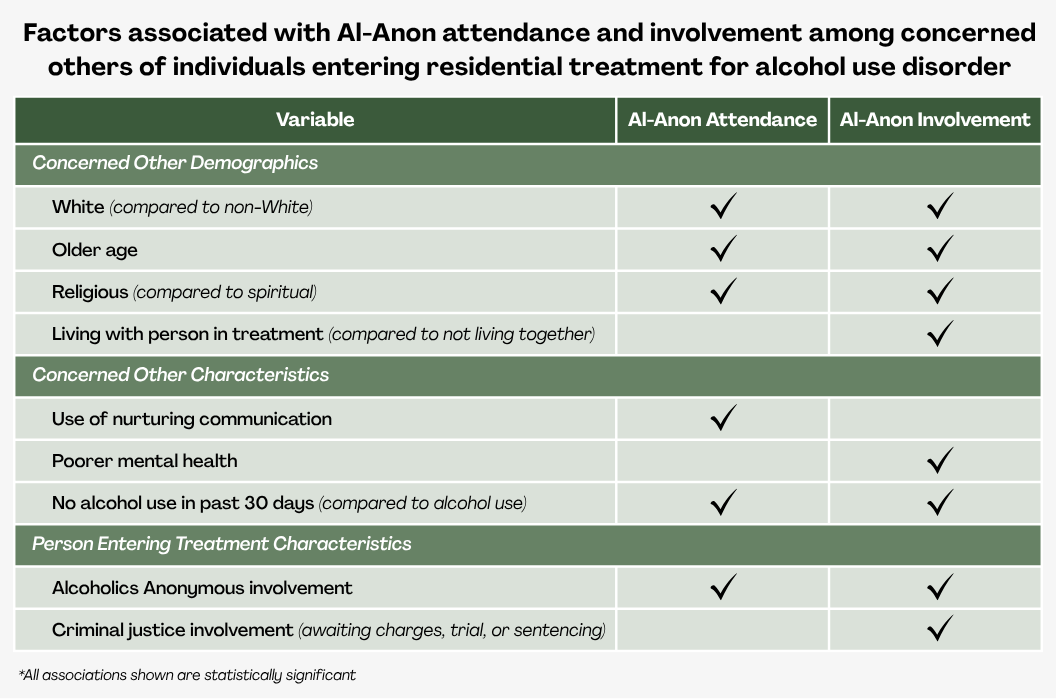
Figure. Demographic and other characteristics associated with Al-Anon meeting attendance and involvement among COs of adults entering residential treatment for alcohol use disorder. Check marks indicate statistically significant associations between each variable and the respective Al-Anon participation outcome. Click image to enlarge.
Why do these findings matter?
Al-Anon can provide valuable support for people affected by someone else’s drinking. However, not all COs may be equally likely to participate. This study highlights the importance of tailoring outreach and referrals, as well as support services, to COs’ different needs and circumstances. For example, younger and racially diverse COs might need extra encouragement to attend Al-Anon or might benefit from more culturally responsive alternatives. Treatment programs can play an important role by routinely connecting COs with these resources, but outreach should also reach people whose loved ones are not in treatment.
Every study has limitations. What are the limitations in this study?
Because participants were COs of people entering residential treatment and had agreed to participate in the study, they may differ from COs whose loved ones receive other forms of support or are not seeking treatment. The findings may also be less representative of spouses and COs who live with the person drinking, as most COs in the study were not married to or living with the person entering treatment. Finally, the study did not account for COs’ participation in other mutual-help groups.
For more information:
Family members and friends worried about a loved one’s drinking can find understanding and support with Al-Anon and Learn to Cope. The National Institute on Alcohol Abuse and Alcoholism has tips and resources for people who want to cut back or stop drinking. For additional information and drinking self-help tools, please visit our Addiction Resources page.
— Kira Landauer, MPH
Want CE credit for reading BASIS articles? Click here to visit our Courses Website and access our free online courses.