ASHES, Vol. 22(11) – How paying people to quit smoking can work: Findings from a clinical trial for those experiencing homelessness
In the United States, approximately three quarters of those experiencing homelessness are smokers. Many people experiencing homelessness who smoke want to quit; however, daily stressors and structural and systemic inequities create barriers to doing so. Contingency management (CM), which uses positive reinforcement, often through a financial incentive, to promote consistent engagement with an intervention or positive behavior, might help people experiencing homelessness quit smoking. This week, ASHES reviews findings from a pilot randomized clinical trial of CM for smoking cessation among people experiencing homelessness by Dian Gu and colleagues.
What was the research question?
Does contingency management promote smoking cessation among those experiencing homelessness?
What did the researchers do?
The researchers recruited 83 participants experiencing homelessness to complete a smoking cessation clinical trial. Over six months, participants completed six study assessments and received an average $12 each for each one. Participants could attend up to 25 abstinence assessment visits, where they self-reported abstinence in the past seven days, as verified by carbon monoxide levels. Attending these assessment visits allowed for opportunities to earn additional financial incentives depending on group assignment. The intervention group received CM in the form of additional gift cards escalating in amount for each abstinence assessment visit (for a maximum potential of $475), contingent on smoking abstinence. The control group received additional gift cards in fixed amounts (for a maximum potential of $125) for just completing a visit. The researchers reported descriptive statistics on the rates of smoking cessation and used logistic regression and generalized estimated equations to analyze the effect of the intervention.
What did they find?
At the six-month follow-up, 31% of the CM participants were verifiably abstinent from smoking in the past seven days, compared to about 12% of controls. The median total number of carbon monoxide-negative samples throughout the first 6 months was 9 in the CM group and 4 in the control group (see Figure). On average, CM participants received about $177 in additional incentives and controls received about $80. At the 6-month follow-up, participants in the CM group had 4.15 greater odds compared to controls of being abstinent from smoking in the past seven days while accounting for other demographic factors
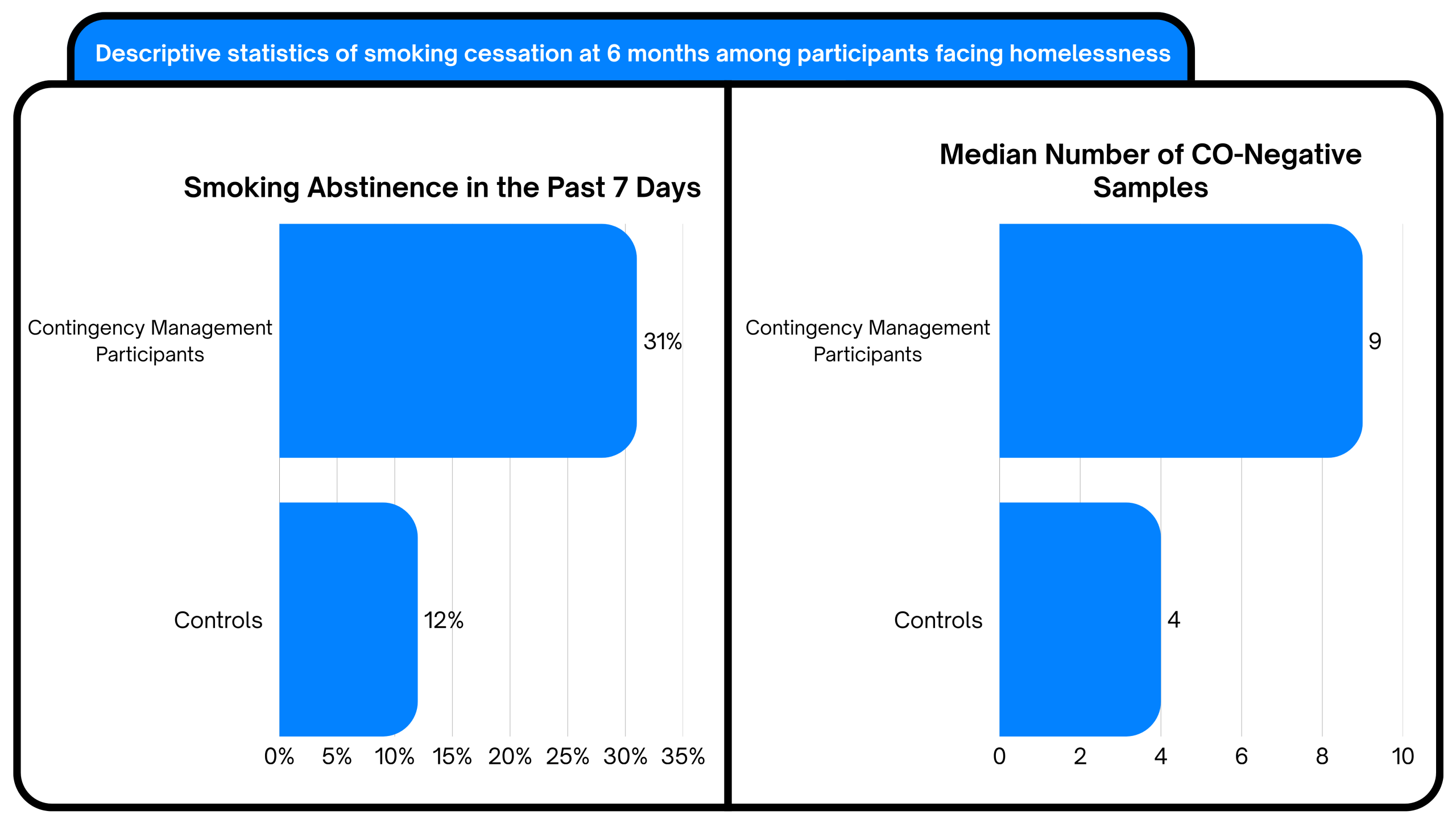
Figure. Descriptive statistics of smoking abstinence in the past seven days and median number of negative carbon monoxide (CO) samples at the six-month follow up among participants facing homelessness. Click image to enlarge.
Why do these findings matter?
These findings suggest that providing financial incentives might[b] be a means of reducing the socioeconomic barriers related to smoking cessation in those experiencing homelessness. Financial incentives offer an opportunity to relieve stress by allowing people facing homelessness to afford some daily necessities or nicotine replacement supplies. As a result, those who are homeless and working towards quitting smoking may feel more confident to sustain positive changes as they gain independence and continual physical markers of progress.
Every study has limitations. What are the limitations of this study?
The study was conducted during the COVID-19 pandemic, which may limit the generalizability of the results due to increased stressors and disruption of usual homeless support services during that period. Additionally, the smaller sample size of this pilot study limits the statistical power of the results.
For more information:
SAMSHA offers information and a list of resources for individuals looking to quit smoking. General resources and programs for those experiencing homelessness can be found here. Additional resources can be found at the BASIS Addiction Resources page.
— Justin Huynh, MPH
Want CE credit for reading BASIS articles? Click here to visit our Courses Website and access our free online courses.