The DRAM Vol. 22(9) – How a smartphone app uses family to help prevent DWI
Driving While Intoxicated (DWI) is a major cause of death in the United States with about 32 people killed everyday in a drunk driving crash. One strategy to prevent DWI are Ignition Interlock Devices (IID) which are often installed in the vehicles of those with a DWI conviction. IIDs require drivers to pass a breathalyzer test for the vehicle to start with multiple failed tests resulting in an IID lockout event. Although IIDs are effective at preventing DWI during their period of use, after it is removed users often continue to re-offend. It is crucial to understand what else can be done alongside IIDs to prevent longer-term recidivism among DWI offenders. This week, The DRAM reviews a study by W. Gill Woodall and colleagues that trials a smartphone app that uses family-involved therapy approaches to reduce alcohol use and prevent IID lockout events.
What was the research question?
How does a smartphone app intervention using family-involved therapy methods affect alcohol use and IID lockout events for individuals with a DWI conviction?
What did the researchers do?
The researchers recruited 123 pairs of individuals with first time DWI conviction and a concerned family member (total N = 246) and randomly assigned them to either the B-SMART app—consisting of four modules on (1) living with an IID, (2) reducing alcohol use in the family context, (3) family activities that do not involve alcohol, and (4) communication skills—or a state IID information page (control group). Participants with a DWI conviction responded to online questionnaires at three waves: baseline, 3-, and 9-month follow ups on their alcohol use, and lockout event data was obtained from IID providers. Family member participants also reported their counterpart’s alcohol use, separately. The researchers estimated the association between group assignment and IID failed tests and lockout events, while accounting for important demographic risk factors (e.g., sex, education). They also compared the percentage of recent alcohol usage in each experimental condition, at different timepoints.
What did they find?
B-SMART app users were at about 0.4 times decreased risk to have a lockout event in comparison to controls. Demographically, males had about 3.0 times increased risk to have a lockout event compared to females, and those with a college education or higher had about 2.8 times increased risk to have a lockout event compared to those with any education less than college. (See Figure). No significant associations were found between failed IID tests and any predictors. B-SMART users reported less alcohol use in the past 30 days at nine months follow up (~17%) compared to controls (~35%). Family members in the B-SMART group also reported lower alcohol use by their family members with the DWI conviction (~11%), compared to controls (~26%).
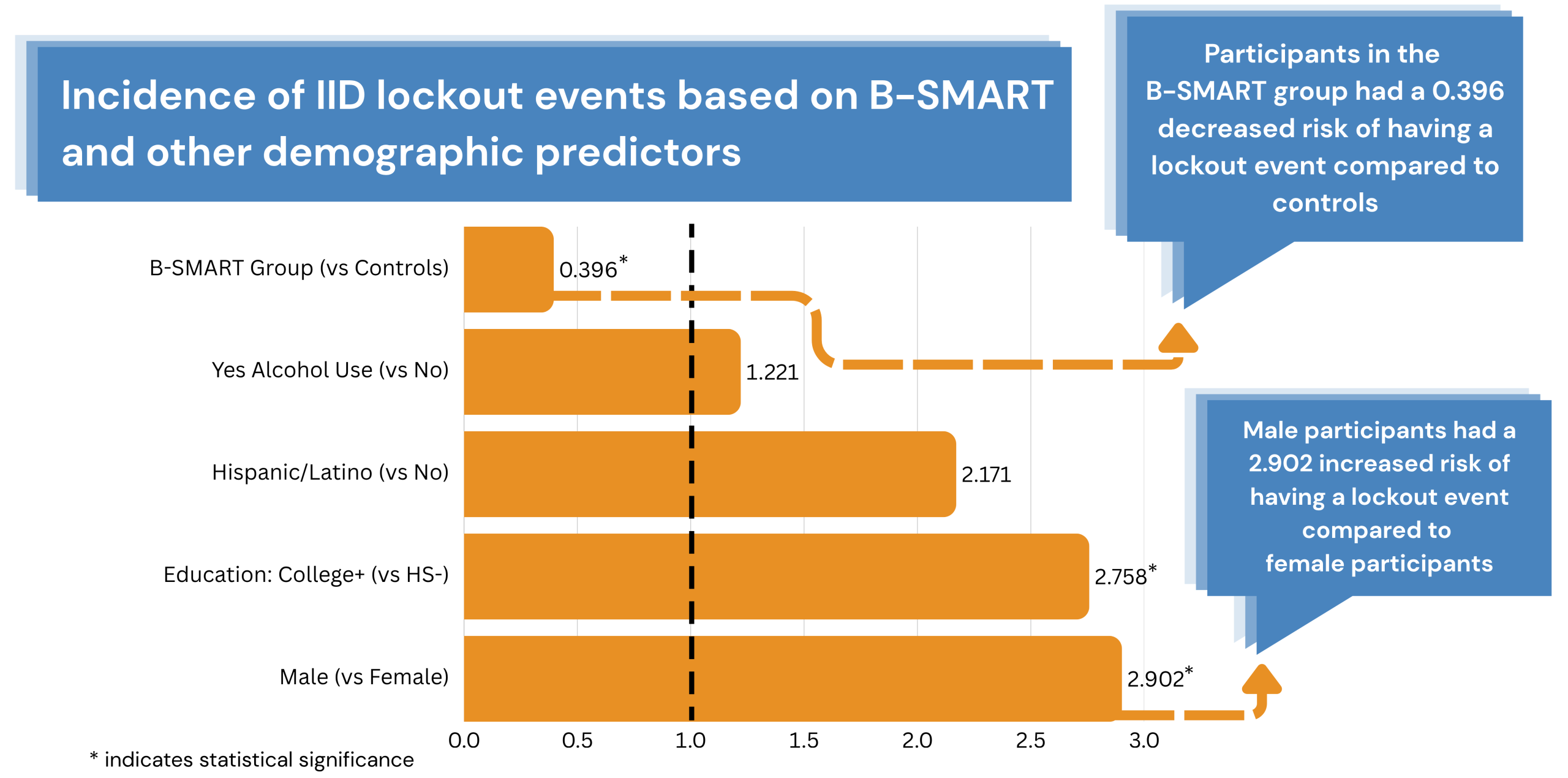
Figure. Incidence rate ratio of B-SMART intervention and other demographic predictors for IID lockout events. * denotes statistical significance. Click image to enlarge.
Why do these findings matter?
The findings show that B-SMART is a promising tool for reducing alcohol use and preventing IID lockout events among first time DWI offenders, and could help to prevent DWI recidivism. By targeting those with a first time conviction, B-SMART can deploy prevention early on to reduce future harms, though updates to the app could include materials targeting those with multiple DWI convictions. Importantly, B-SMART highlights the success of involving family in interventions for alcohol and other substance use disorders to start and sustain recovery. Overall, mobile health interventions like B-SMART offer an accessible and scalable way to reach those struggling with alcohol problems who may be unable or unwilling to use traditional treatment approaches.
Every study has limitations. What are the limitations of this study?
The study was only able to examine the B-SMART apps’s effects on IID lockouts, not DWI recidivism. The researchers were not able to actually measure any reduced DWI activity that could have occurred such as with a borrowed vehicle. Additionally, this research took place during the COVID-19 pandemic, so participants may have been less likely to need or want to drive due to stay at home orders and the shutdown of businesses, which could have impacted the number of lockout events.
For more information:
Visit the National Institute on Alcohol Abuse and Alcoholism for tips and resources for people struggling with problem drinking. For additional information and drinking self-help tools, please visit our Addiction Resources page.
— Justin Huynh, MPH
Want CE credit for reading BASIS articles? Click here to visit our Courses Website and access our free online courses.