The WAGER, Vol. 31(9) – Understanding why players engage with a casino-based responsible gambling program
Casino-based responsible gambling (RG) programs are designed to provide immediate, in-person support to gamblers within the gambling environment. Program staff connect with players to provide RG information, education, and resources. Understanding why casino patrons engage with program staff can help program developers identify ways to reach a broader range of players. This week, The WAGER reviews a study by Gray E. Gaudett and colleagues that examined why casino players choose to interact with casino-based program staff and whether reasons for doing so relate to players’ gambling-related characteristics.
What were the research questions?
(1) Why do casino players interact with casino-based RG program staff? (2) Do players with contrasting reasons for interacting with program staff differ in their gambling-related characteristics?
What did the researchers do?
This research was situated at three Massachusetts casinos, which house independently-staffed RG centers. Between March and July 2023, RG center staff (then known as GameSense Advisors, now known as PlayWell Advisors) invited players who had a meaningful interaction1 with them to complete an online survey. The analytic sample included 254 players, out of 2,456 eligible players. Participants answered questions about why they interacted with an Advisor, their positive play beliefs and behaviors, and problem gambling symptoms. The researchers used Latent Class Analysis to identify groups of players with similar reasons for interacting with an Advisor, and one-way ANOVAs to see whether these groups differed in their gambling-related characteristics.
What did they find?
The researchers identified three groups of players based on their reasons for interacting:
- Comprehensive Information Seekers (31.1%)
- RG Curious (42.9%)
- Externally Inspired (26.0%)
Comprehensive Information Seekers gave a broad range of reasons for interacting with an Advisor, including wanting to learn about RG and RG tools as well as wanting promotional items (see Figure). The other two groups had more specific reasons for engaging. RG Curious players were primarily interested in learning how to be a responsible gambler, with less interest in learning about specific RG tools, such as voluntary self-exclusion. Externally Inspired players primarily interacted because an Advisor approached them or because they wanted free giveaways or promotional items, rather than because they were interested in RG or RG tools (such as the PlayMyWay gambling budget tool). Comprehensive Information Seekers scored lower on personal responsibility (one aspect of positive play beliefs) and reported more frequent problem gambling symptoms of problem gambling than the Externally Inspired group.
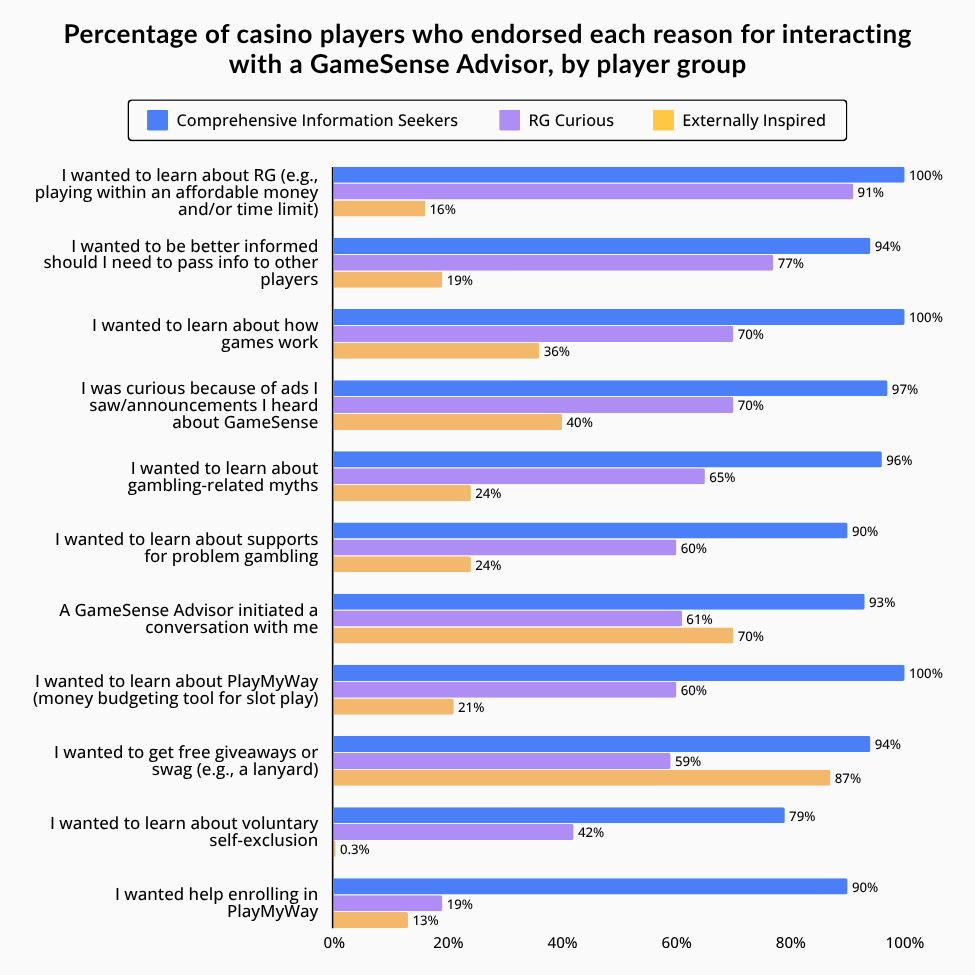
Figure. Percentage of casino players in three Massachusetts casinos who endorsed each reason for interacting with a GameSense Advisor, by the three player groups identified in the Latent Class Analysis. Click image to enlarge.
Why do these findings matter?
Players may engage with RG programs for different reasons. RG programs can use these different motivations to develop multiple diverse ways to attract and engage players. For example, RG programs could actively promote their services and resources to attract players who are curious and want to learn more, while also using giveaways and swag as an opening to introduce RG to players who may not otherwise seek it out.
Every study has limitations. What are the limitations in this study?
The study only included casino players who interacted with a GameSense Advisor, and past research indicates that such players represent a small minority of casino patrons. Moreover, only about 10% of players invited to participate completed the survey. These factors could introduce selection bias and limit how well the findings represent all players who engage with GameSense, as well as the broader population of casino players.
For more information:
Visit the GameSense website for RG information and resources. Individuals who are concerned about their own or someone else’s gambling may benefit from visiting the National Council on Problem Gambling. For additional resources, including gambling and self-help tools, visit our Addiction Resources page.
— Kira Landauer, MPH
Want CE credit for reading BASIS articles? Click here to visit our Courses Website and access our free online courses.
________________
1. Meaningful interactions included demonstrations of RG tools or resources as well as exchanges involving more in-depth conversations about RG tools and gambling-related concerns and behaviors.