The DRAM, Vol. 22(7) – How exposure to the brain disease model of addiction shapes readiness to change drinking behavior
“If Nic were not ill, he would not lie. If Nic were not ill, he would not steal. If Nic were not ill, he would not terrorize his family…. He has a disease, but addiction is the most baffling of all diseases, unique in the blame, shame, and humiliation that accompany it.”
David Sheff’s portrait of his son Nic’s drug addiction, from the memoir Beautiful Boy, illustrates the brain disease model of addiction – the view that addiction is a chronic medical condition rooted in the brain, rather than a personal choice. This model is well supported by scientific research and has helped reduce addiction stigma. In doing so, it has helped usher in essential public health advances, such as the requirement that addiction treatment is insured like other diseases in the US. However, it might also encourage people to view addiction as biologically determined and therefore very difficult, if not impossible, to change. This week, The DRAM reviews a study by Yi-Hao Liu and colleagues that explored whether thinking of addiction as a brain disease lowers drinkers’ readiness to change their drinking behavior.
What was the research question?
Among college students who regularly drink alcohol, does exposure to the brain disease model of addiction reduce readiness to change?
What did the researchers do?
The researchers conducted two experimental studies. In Study 1, participants were college students who drank at a hazardous level. In Study 2, they were students who drank at least weekly. In both studies, participants were assigned to one of two groups. One group read statements supporting the brain disease model, while the other read statements supporting the idea of addiction as a choice, such as “The best way to overcome addiction is to rely on your own willpower.” After reading the statements, participants completed measures of readiness to change and other concepts. In Study 1, they reported on their readiness to change their drinking, and in Study 2 they reported on their readiness to change unwanted habits more broadly. The researchers studied how the two groups differed on all study outcomes.
What did they find?
Across studies, the two groups only differed in terms of readiness to change. In Study 1, those exposed to the “addiction is choice” statements had higher scores on the readiness to change drinking measure, and in Study 2, they had higher scores on the measure capturing readiness to change unwanted habits. There were no differences between groups on the other study outcomes (see Figure).
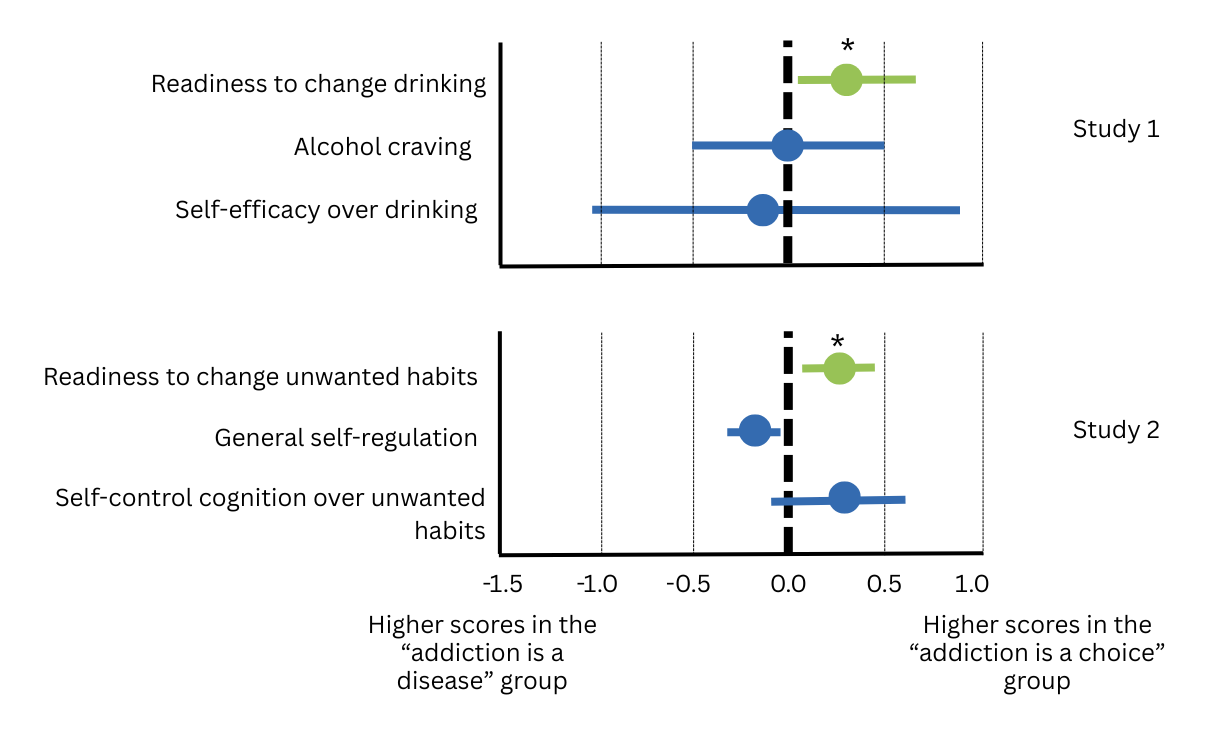
Figure. Mean differences (circles) and 95% confidence intervals (horizontal lines) showing the differences between the “addiction is a disease” and “addiction is a choice” group on the study outcomes, Studies 1 and 2. Statistically significant differences are indicated by the confidence intervals not overlapping zero and the * symbol. Click image to enlarge.
Why do these findings matter?
Those with stronger readiness to change have better recovery outcomes when it comes to problem drinking and other expressions of addiction. Therefore, it is important that the brain disease model might reduce people’s readiness to change by communicating the idea that recovery is beyond personal control. An alternative perspective is the responsibility without blame framework, which recognizes powerful biological and environmental influences on addictive behavior but also emphasizes that people are capable of taking meaningful steps toward recovery.
Every study has limitations. What are the limitations of this study?
It is unclear whether the effects documented in these studies were big enough or stable enough to change drinking habits. Also, because the researchers did not use a neutral control group, we cannot determine whether the “addiction is a disease” framing lowered readiness to change, or the “addiction is a choice” framing increased readiness to change.
For more information:
Visit the National Institute on Alcohol Abuse and Alcoholism for tips and resources for people struggling with problem drinking. For additional information and drinking self-help tools, please visit our Addiction Resources page.
–Heather Gray, PhD
Want CE credit for reading BASIS articles? Click here to visit our Courses Website and access our free online courses.