STASH, Vol. 22(7) – State-level kratom policies and overdose deaths where kratom is detected
Kratom is a tree native to Southeast Asia whose leaves contain compounds that can produce stimulant-like effects at lower doses and opioid-like effects at higher doses. The leaves are processed into products such as powders, capsules, teas, and extracts, which are marketed for boosting energy and mood, relieving pain, or helping with opioid withdrawal. However, kratom is not approved by the U.S. Food and Drug Administration for any medical use, and evidence on its benefits and risks remains limited. Some people may develop a dependence or experience withdrawal after repeated use, and it has been associated with a range of adverse effects. Kratom-only overdose deaths are rare; when kratom appears in fatal overdoses, other substances are usually involved. In the U.S., kratom is not regulated at the federal level, and state policies vary widely, from bans to regulatory approaches to no specific policies. This week, STASH reviews a study by Lekshmi Rita-Venugopal that examined whether state-level kratom policies are associated with differences in rates of overdose deaths in which kratom is detected.
What was the research question?
Do rates of overdose deaths in which kratom is detected vary by state-level kratom policies?
What did the researcher do?
This study used data from the State Unintentional Drug Overdose Reporting System, focusing on 45 U.S. jurisdictions (states and Washington D.C.) that reported fatal overdoses in which kratom was detected between 2020–2024. In these cases, kratom was identified in toxicology or case records, but we don’t know whether it played any role in the overdose, especially since other substances are often involved. States were grouped into three policy categories: (1) controlled states, where kratom is classified as a controlled substance; (2) regulated states, where kratom is legal but subject to regulations like age restrictions or labeling requirements; and (3) states with no statewide regulation or control. The researcher used negative binomial regression to compare rates of kratom-detected overdose deaths (among all overdose deaths) across policy categories, while accounting for pre-existing differences between states, broad changes over time, and the extent of deaths attributable to opioid-stimulant co-use in each state.
What did they find?
Over the five-year study period, kratom was detected in 5,208 overdose deaths across the included jurisdictions, accounting for 1.82% of all fatal overdoses. Compared with controlled states, kratom detection rates in fatal overdoses were more than three times higher in regulated states and more than four times higher in states without statewide regulation or control (see Figure).
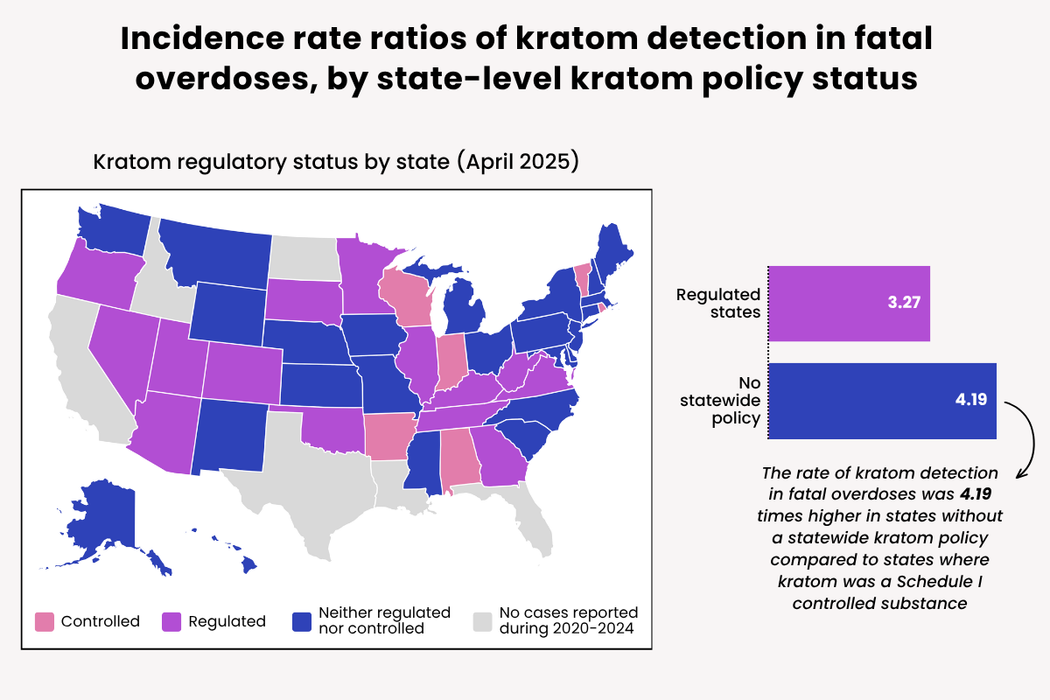
Figure. Incidence rate ratios of kratom detection in fatal overdoses, by state-level kratom policy status. The map depicts kratom regulatory status by state as of April 2025. Click image to enlarge.
Why do these findings matter?
As kratom use continues to rise, more research is needed to better understand its potential benefits, risks, and relationship to polysubstance use, particularly because kratom is often detected alongside other substances in fatal overdoses. These findings also highlight the importance of improving overdose surveillance through more consistent toxicology testing and standardized reporting, which can help researchers and public health officials better monitor patterns of kratom use and related harms. These results reinforce the value of asking about kratom use as part of a comprehensive substance use assessment and including kratom in conversations about overdose risk and prevention.
Every study has limitations. What are the limitations of this study?
This study looks at patterns across states, so it can’t tell us whether kratom policies directly caused differences in rates of overdose deaths where kratom was detected. Although the researcher controlled for important characteristics, it is difficult to fully isolate the effects of kratom policies on outcomes such as overdose deaths. For instance, differences in how states test for and report kratom may affect whether it is found in toxicology reports, which can make comparisons across states less precise.
For more information:
If you are worried that you or someone you know is experiencing addiction, the SAMHSA National Helpline is a free treatment and information service available 24/7. For additional general resources and tools, please visit the BASIS Addiction Resources page.
— Kira Landauer, MPH
Want CE credit for reading BASIS articles? Click here to visit our Courses Website and access our free online courses.