The WAGER, Vol. 31(4) – How can one’s gambling habits predict suicide risk?
Suicide is a potential severe outcome for individuals with gambling problems. With the public health burden of gambling continually rising as gambling markets grow and engagement becomes normalized, it is crucial to understand in greater depth how different ways of gambling can shape suicide and other outcomes. This week, The WAGER reviews a study by Heather Wardle and colleagues that explored the impact of differing gambling behaviors on suicide risk.
What was the research question?
How do differing gambling behaviors relate to suicidal ideation?
What did the researchers do?
The study used longitudinal data from an online survey assessing the impact of the COVID-19 pandemic on gambling in the United Kingdom. The researchers analyzed data from 3927 adults who gambled at least monthly in June 2020 for wave 1 and 3195 adults in November 2020 for wave 2. At each wave, the researchers collected data on participant gambling activities, behaviors, and impacts in the prior three months. They used latent class analysis to create groups of participants with similar gambling behaviors and then used logistic regression to test whether the groups differed in terms of their risk of suicidal ideation.
What did they find?
The researchers identified five groups:
- Group 1: 548 participants who mostly gambled in-person and on horses and sports
- Group 2: 2756 participants who mostly gambled online and on horses and sports
- Group 3: 153 participants who gambled both online and in-person, and mostly on horses and sports
- Group 4: 272 participants who gambled online and engaged in many different gambling activities
- Group 5: 198 participants who gambled both online and in-person and engaged in many different gambling activities.
At wave one, about 13% of all participants reported suicidal ideation in the past three months and just under 2% reported a suicide attempt in the past three months. Suicidal ideation and suicide attempts were highest in group 5 with rates, respectively, at about 28% and 19%.
At wave two, group 5 continued to have the highest rates of suicidal ideation and suicide attempts with rates at about 35% and 28%. When testing odds of suicidal ideation, group 5 was the only group with statistically significant higher odds in comparison to groups 1, 3, and 4 (see Figure).
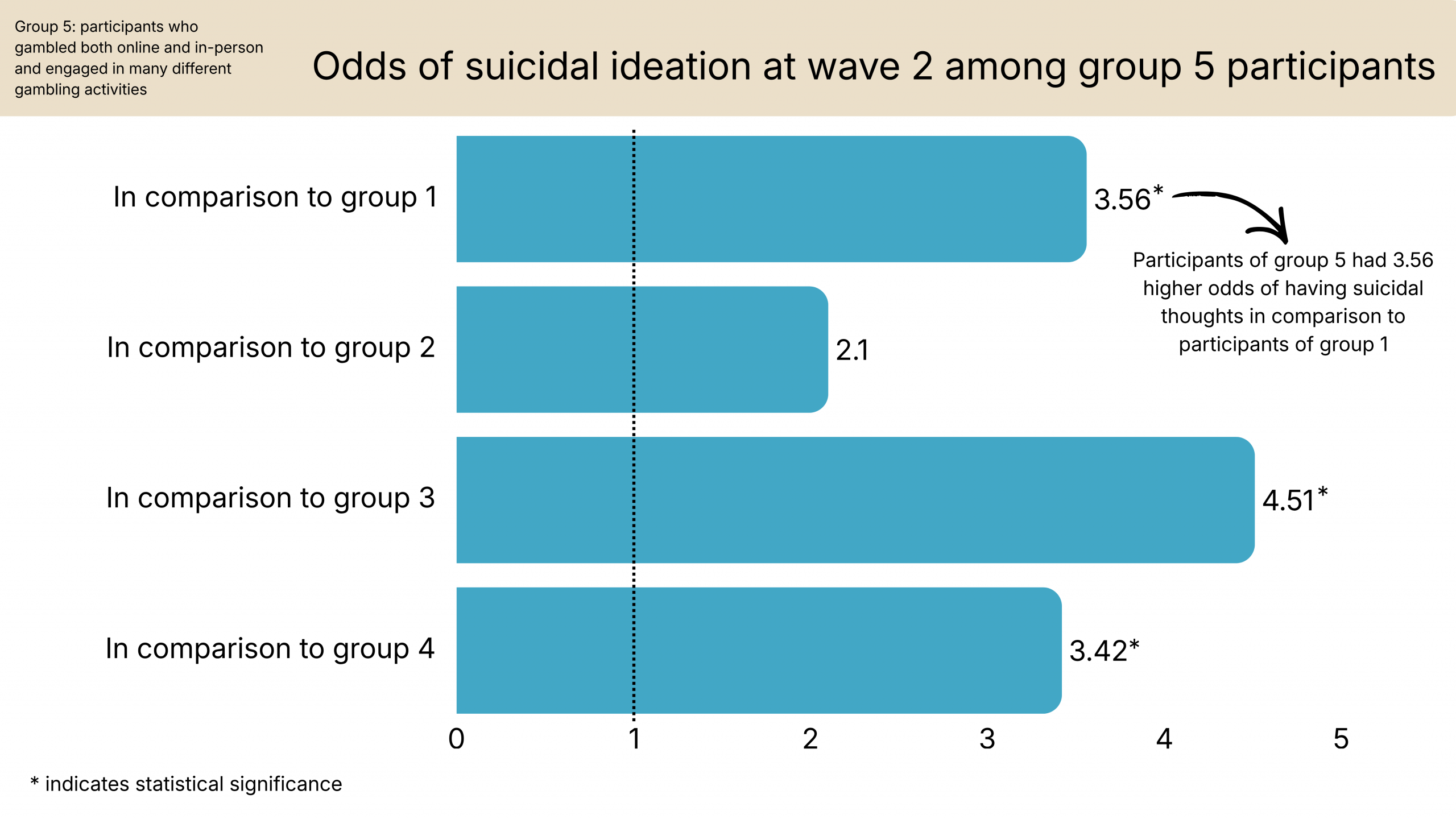
Figure. Odds ratios for wave 2 suicidal ideation, adjusted for wave 1 suicidal ideation or attempt, participant sociodemographic characteristics, and other health problems. Click image to enlarge.
Why do these findings matter?
Individuals who engage in more gambling activities, both online and in-person, may be more likely at risk for suicide. This information may help healthcare professionals tailor treatment for greater effectiveness, thus emphasizing the importance of including gambling in psychosocial assessments to better understand how people gamble and their risk for gambling-related harms. People with gambling problems should also be screened for suicide risk and be targets of suicide prevention campaigns. Further, these findings support regulatory actions working to ban gambling mix-product cross promotions that use bonus incentives to entice customers to engage in multiple types of gambling.
Every study has limitations. What are the limitations in the study?
The data used in this study was collected during the COVID-19 pandemic; thus, the results may be impacted by unmeasured COVID-related experiences on both participants’ lives and the gambling landscape at the time. The use of self-report data may be subject to recall or social desirability bias, the latter being potentially prominent due to the sensitive nature of suicide.
For more information:
Visit the National Council on Problem Gambling or Gamblers Anonymous to access information for individuals with gambling problems. Additional resources on gambling can be found on the BASIS Addiction Resources page.
— Justin Huynh, MPH
Want CE credit for reading BASIS articles? Click here to visit our Courses Website and access our free online courses.