ASHES, Vol. 22(4) – Stepping up substance use: An analysis of the Gateway Theory
The Gateway Theory of substance use posits that the use of more socially acceptable substances encourages the use of harder and less socially accepted drugs. Nicotine vaping, for example, appears to promote future marijuana use. Could social learning – the process by associating with rule-breaking peers increases one’s own tendency to break rules – be the first step in the causal chain? Perhaps teens who spend more time with rule-breaking peers are likely to vape nicotine, which, in line with the Gateway Theory, increases the likelihood of future marijuana use. This week, ASHES reviews a study by Thomas Wojciechowski that explored this possibility.
What were the research questions?
(1) Does associating with rule-breaking peers increase the likelihood of marijuana use? (2) Does nicotine vaping help explain why teens who associate with rule-breaking peers later start using marijuana?
What did the researchers do?
The researchers used five waves of data from the ABCD study, a nationally representative longitudinal dataset of 11,880 U.S. youth. Collected data included marijuana use, nicotine use, association with friends who break rules (i.e., shoplifting, skipping school, being suspended from school), and demographic characteristics. Using generalized structural equation modeling, the researchers assessed the effects of having rule-breaking friends at Wave 3 (age 12-13) on marijuana use at Wave 5 (age 14-15), and whether nicotine use at Wave 4 (age 13-14) mediated this relationship.
What did they find?
Though relatively few participants reported lifetime marijuana (3.4%) or vape use (1.4%), the prevalence of both behaviors increased as the number of rule-breaking friends increased, in line with social learning theory. Nicotine vaping at Waves 3 and 4, older age at Wave 5, female sex, having more rule-breaking friends at Wave 3, and weaker parental monitoring at Wave 4 all predicted marijuana use at Wave 5 (see Figure). Mediation analyses also provided evidence for the Gateway Theory/social learning explanation, in that nicotine vaping at Wave 4 partially accounted for the relationship between the number of rule-breaking friends at Wave 3 and marijuana use at Wave 5.
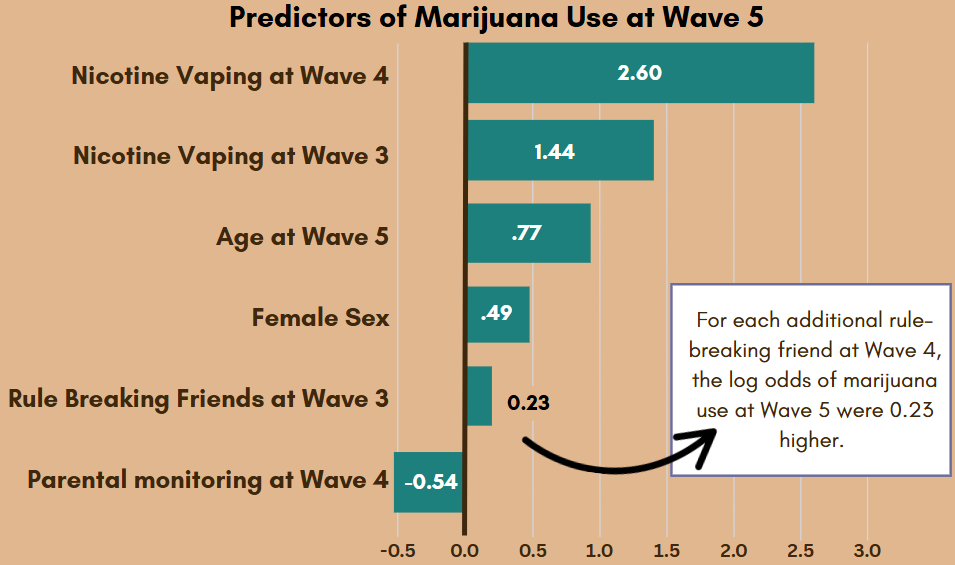
Figure: Displays the log-odds of statistically significant predictors of reporting marijuana use at Wave 5. Log odds are interpreted differently from more traditional odds and odds ratios but can be easily interpreted using a conversion table. Click image to enlarge.
Why do these findings matter?
These findings emphasize the importance of adolescent-focused nicotine prevention and cessation programs. Though associating with rule-breaking friends independently contributed to marijuana use, nicotine initiation appears to be an important chain in this relationship. Increased focus from parents and school personnel, such as resource officers and guidance counselors, on nicotine initiation and the introduction of nicotine prevention programs, like the Truth Initiative, may help reduce other substance use as well.
Every study has limitations. What are the limitations in this study?
The researchers measured peer associations based on the number of friends who had engaged in distinct rule-breaking behaviors. A more complete assessment would take into consideration the extent to which peers reinforce pro-substance use attitudes and behaviors.
For more information
Individuals who want to quit smoking or vaping may benefit from engaging with the American Lung Association. Others who want to learn more about the effects of cannabis as well as potential cannabis harms should engage with the Cleveland Clinic’s informational resources. Additional resources can be found at the BASIS addiction resources page.
—John Slabczynski
Want CE credit for reading BASIS articles? Click here to visit our Courses Website and access our free online courses.