ASHES, Vol. 22(2) – Perspectives on cigarette cessation among individuals with intellectual disabilities and their support professionals
Harms associated with cigarette use disproportionately impact certain populations, including those with intellectual disabilities (ID). Addressing these individuals’ unique harms might require tailored approaches that consider unique needs. This week, ASHES reviews a study by Amalia Udeanu and colleagues that explored cigarette smoking and cessation among people with ID and insights from their direct support professionals.
What was the research question?
How do individuals with ID living in a residential setting, and their direct support professionals (DSPs), perceive cigarette smoking and cessation?
What did the researchers do?
The researchers recruited 20 participants from residential service organizations – 10 individuals with ID (aged 18+) who regularly smoked and 10 of their DSPs. The researchers conducted face-to-face interviews, asking questions about the smoking experiences of people with ID and the perspectives of their DSPs. They transcribed the interviews and used thematic analysis to identify overarching themes.
What did they find?
Six overarching themes emerged (see Figure for example quotations for each theme):
- Smoking initiation: Individuals with ID initiated smoking due to peer pressure, the desire to imitate family/friends, or as a means of developing their own identity.
- Current cigarette smoking: Cigarette smoking became a routine behavior that was a source of social interaction and offered immediate gratification (e.g., reduced anxiety).
- Cigarette access and regulation in residential services: DSPs often controlled where/when/how much the individuals could smoke and used cigarettes to incentivize good behavior. This proved to be a point of contention among individuals with ID, who felt that it was an unethical limit on their autonomy.
- Motivation to quit smoking: Individuals with ID expressed a desire to quit smoking for health reasons but were ambivalent about their ability to quit due to lack of support and strong nicotine dependence.
- Barriers to smoking cessation: Both groups cited barriers, including a perceived lack of confidence in their ability to quit smoking, social factors like seeing others smoke, the tendency to minimize smoking harms, and lack of awareness of smoking cessation interventions.
- Perceived smoking cessation aids: Individuals with ID identified distraction techniques like keeping themselves busy as helpful cessation strategies, while DSPs advocated for a combination of these strategies and professional/pharmacological treatment.
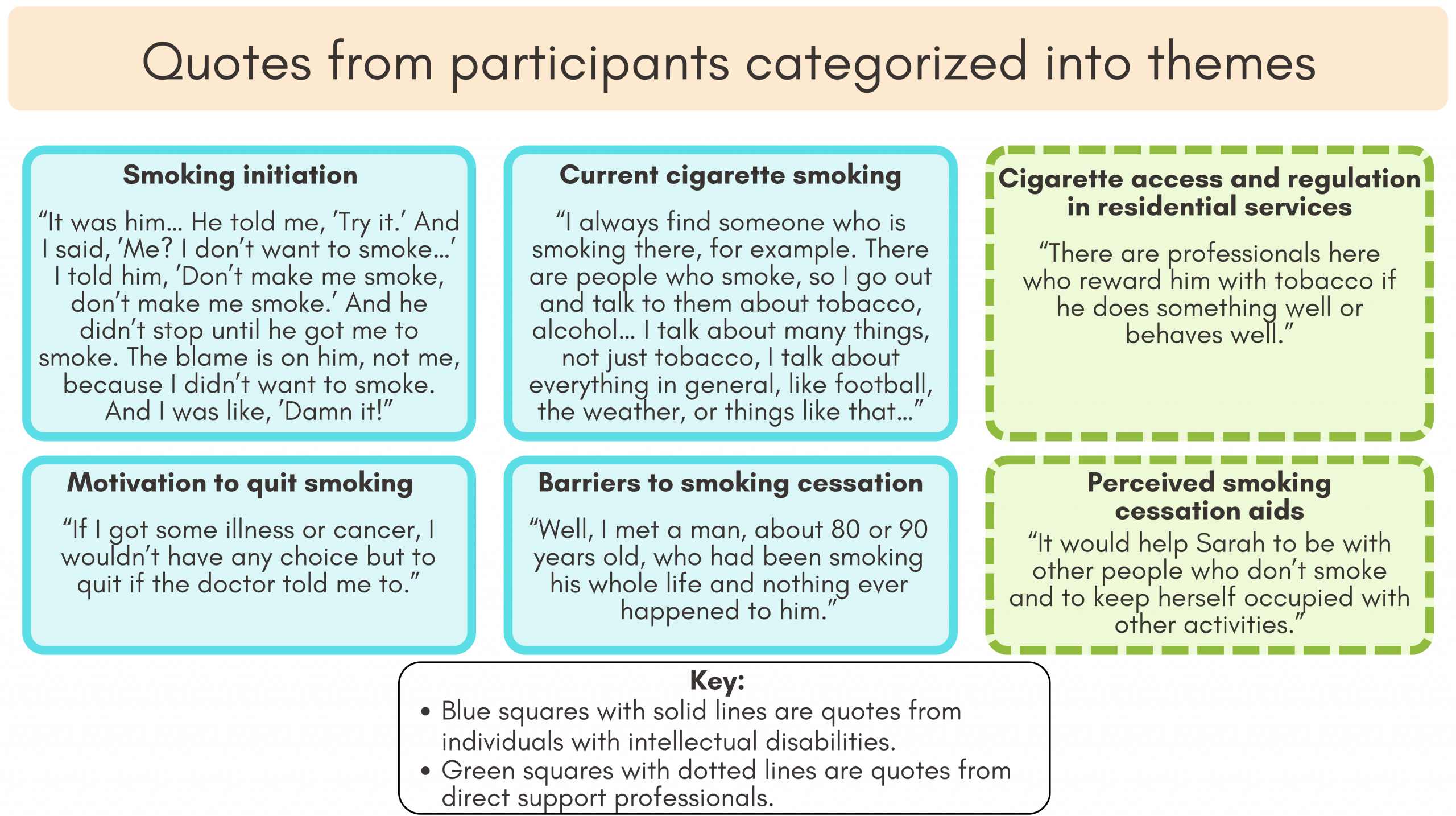
Figure. Quotes from participants categorized into six themes. Click image to enlarge.
Why do these findings matter?
For adults with ID, smoking is often tied to their identity, providing a sense of autonomy and a meaningful way to connect with others. These perspectives can inform tailored smoking cessation strategies. For example, community events might create other ways to connect with others. DSPs also reported using cigarettes to encourage positive behavior. These efforts could inadvertently encourage individuals with ID to smoke as a way to regain their autonomy. Rather than forcibly limiting their cigarette intake, DSPs could discuss the risks associated with smoking and available treatments, to encourage more informed, autonomous decisions about smoking behavior and healthier alternatives.
Every study has limitations. What are the limitations in this study?
Due to communication barriers, some participants needed assistance from their DSP to respond to the questionnaire, which might have altered their responses in favor of the perspectives of the DSP. The sample consisted of individuals from residential settings, so the findings might not be generalizable to those who live more independently or with family/friends.
For more information:
The Disability Network for Tobacco Control and Cancer Prevention supports tobacco prevention/education for individuals with disabilities. SmokeFree offers tools and tips for quitting and maintaining abstinence from smoking tobacco. The Centers for Disease Control and Prevention also provides research and tips about cigarettes and how to quit. For additional self-help tools, please visit the BASIS Addiction Resources page.
— Nakita Sconsoni, MSW
Want CE credit for reading BASIS articles? Click here to visit our Courses Website and access our free online courses.