The WAGER, Vol. 30(13) – Bet my life on it: The relationship between gambling disorder and suicidality
Like other addictive behaviors, gambling disorder is linked with risk for suicidality. This is particularly alarming during an era of gambling expansion. To save lives, public health advocates need to understand this relationship. For example, to what extent does gambling disorder increase the risk for suicidality when co-occurring conditions, such as depression and anxiety, are accounted for? This week, The WAGER reviews a study by Adonay Kidane and colleagues that explored the relationships among gambling disorder, suicidality, and co-occurring conditions.
What was the research question?
How do gambling disorder and other mental health issues relate to suicidality within a large nationally representative sample?
What did the researchers do?
The researchers used two nationally representative Swedish datasets, the National Patient Register (NPR) and the Cause of Death Register (CDR). The NPR includes records of mental health disorder diagnoses, suicide attempts, and more. The researchers used it to identify 3,594 patients diagnosed with gambling disorder between 2005-2019. Using a case-control design, they selected two age- and gender-matched patients from the dataset without gambling disorder, resulting in 10,782 total participants. The researchers then merged in CDR data on completed suicides. Through logistic regression, they explored how gambling disorder and other mental health diagnoses relate to suicidality, which was defined as the presence of either a suicide attempt or completed suicide.
What did they find?
Participants diagnosed with gambling disorder (17.7%) had 2.8 greater odds of suicidality compared to matched controls (1.6%) (see Figure), controlling for demographics and comorbid mental health diagnoses. In this model, substance use disorders had the highest risk increase for suicidality (see Figure).
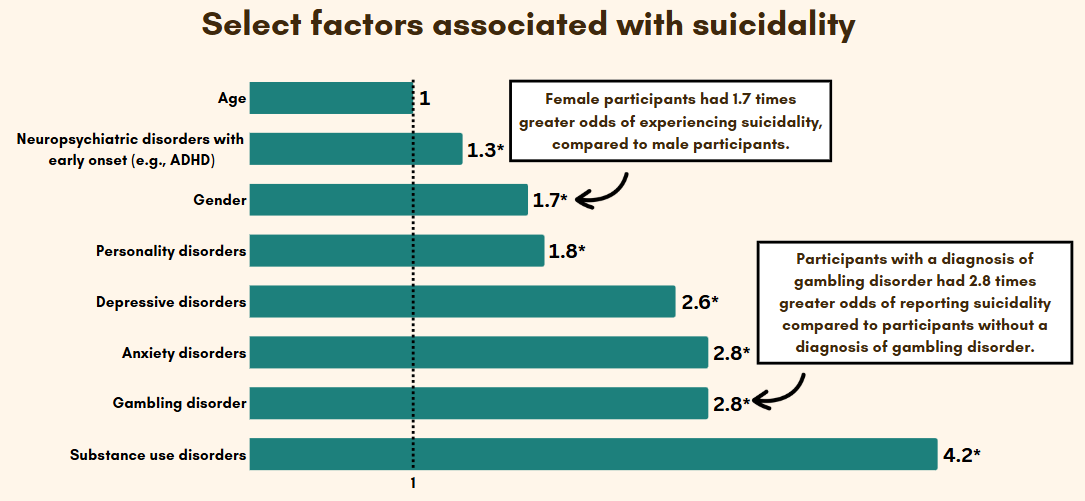
Figure. Displays the odds of suicidality as a function of several potential risk factors among the total sample (N = 10,782). Odds ratios can be interpreted as having X times higher odds of reporting an outcome. * denotes a statistically significant relationship.
Why do these findings matter?
These findings indicate that gambling disorder is associated with increased risk for suicidality even when the researchers accounted for other conditions that might independently create risk for suicide. This underscores the need for routine suicide risk-assessment and safety planning among those experiencing gambling disorder.
Every study has limitations. What are the limitations in this study?
This study was a secondary analysis of existing datasets, so it is limited by how the original data were collected. The NPR, for example, only identifies cases for which a formal diagnosis was made. Most people with gambling disorder do not seek help, so those who do get formally diagnosed might have more severe cases compared to the general population.
For more information:
Individuals who are concerned about their gambling may benefit from engaging with Gamblers Anonymous. Others who are concerned that they may hurt themself may benefit from visiting the CDC webpage on suicide prevention. Additional resources can be found at the BASIS Addiction Resources page.
—John Slabczynski
Want CE credit for reading BASIS articles? Click here to visit our Courses Website and access our free online courses.